
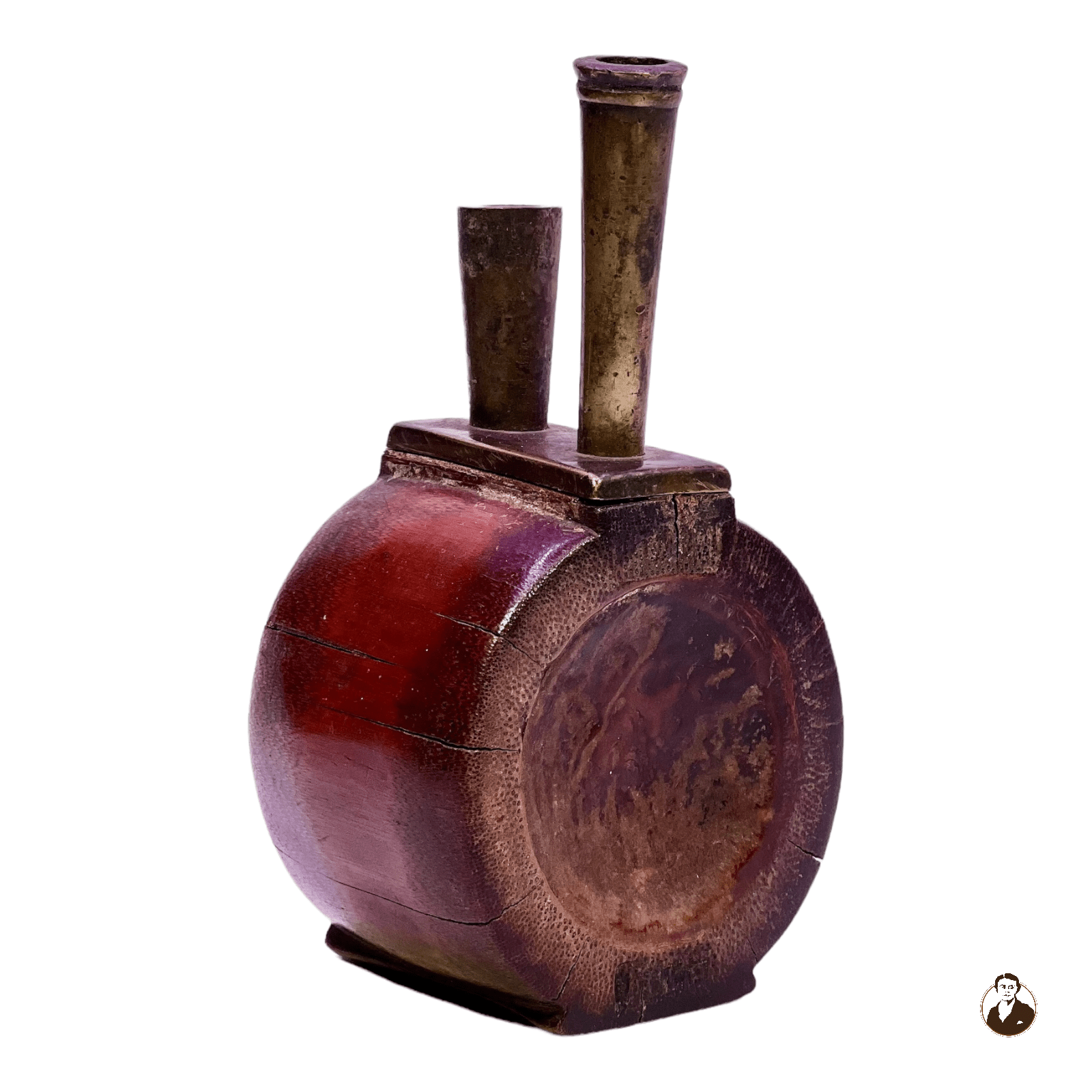
Early 19th-Century Chinese Wood & Metal Hookah Base
China, circa 1800–1850
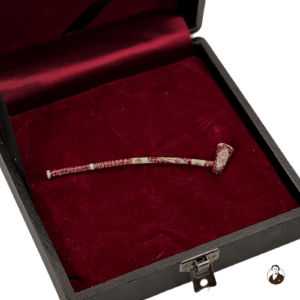
This unusual early 19th-century smoking artifact survives as the base of a larger Chinese hookah or water pipe assembly.
Constructed from a combination of wood and metal, the piece was designed as a functional component within a more complex smoking system. Its surviving fittings and openings indicate that additional tubes, a stem, and an upper smoking bowl would originally have connected to the body.
Although the complete apparatus is no longer present, the base remains historically valuable because its construction preserves evidence of how the original smoking device was assembled and used.
Object Details
Date: Circa 1800–1850
Origin: China
Object Type: Hookah / water pipe base
Materials: Wood and metal
Construction: Multi-component smoking apparatus
Condition: Incomplete surviving base
Period: Early 19th century
Construction and Function
The object appears to have served as the lower reservoir or structural base of a water pipe.
Multiple connection points suggest that the original configuration incorporated additional components extending from the body. These likely included an upper stem and bowl assembly together with tubing used to draw smoke from the chamber.
Its mixed-material construction is especially interesting. The wooden body provides the principal form, while the metal fittings reinforce connection points and help accommodate the mechanical requirements of the smoking system.
Rather than being carved as a single self-contained pipe, the object was designed as part of an assembled apparatus.
A Surviving Fragment of a Larger Object
One of the most compelling aspects of this piece is its incompleteness.
Museum objects do not need to survive in their original entirety to remain informative. In this case, the missing components actually make the surviving structure easier to study, because the openings and fittings reveal how separate pieces once interacted.
The base preserves evidence of:
- modular pipe construction
- tube and stem connections
- mixed wood-and-metal craftsmanship
- early 19th-century smoking technology
- historical repair, handling, and use
It can therefore be studied not simply as a decorative antique, but as a surviving piece of smoking technology.
Historical Context
Water pipes circulated widely across Asia in numerous regional forms, and Chinese smoking implements were made from materials including metal, bamboo, wood, ceramic, and combinations of several materials.
This example is particularly notable for its compact wooden form and metal hardware.
Its design reflects a period when smoking equipment could range from extremely simple portable pipes to complex multi-component devices intended for domestic or social use.
Without the original upper sections, the exact complete appearance of this particular apparatus cannot be reconstructed with certainty. The surviving fittings nevertheless strongly support its identification as part of a larger hookah or water pipe system.
Condition
The object survives in incomplete antique condition.
The principal wooden base and associated metal components remain present, while the original upper stem, bowl, tubes, and other detachable elements are absent.
Surface wear, patina, discoloration, oxidation, and age-related irregularities are consistent with its historical use and survival.
Please review all photographs carefully for a complete visual record of condition.
Collector Context
Early Chinese smoking equipment is collected across several intersecting fields, including:
- Chinese decorative arts
- Antique smoking implements
- Hookahs and water pipes
- Tobacciana
- Asian material culture
- Early smoking technology
- Ethnographic collections
Its age, unusual wood-and-metal construction, and visible evidence of a larger lost assembly make this a particularly interesting study object.
Reviews
There are no reviews yet.