
19th-Century Indian Silver-Plated Copper Hookah
India, circa 1850–1870
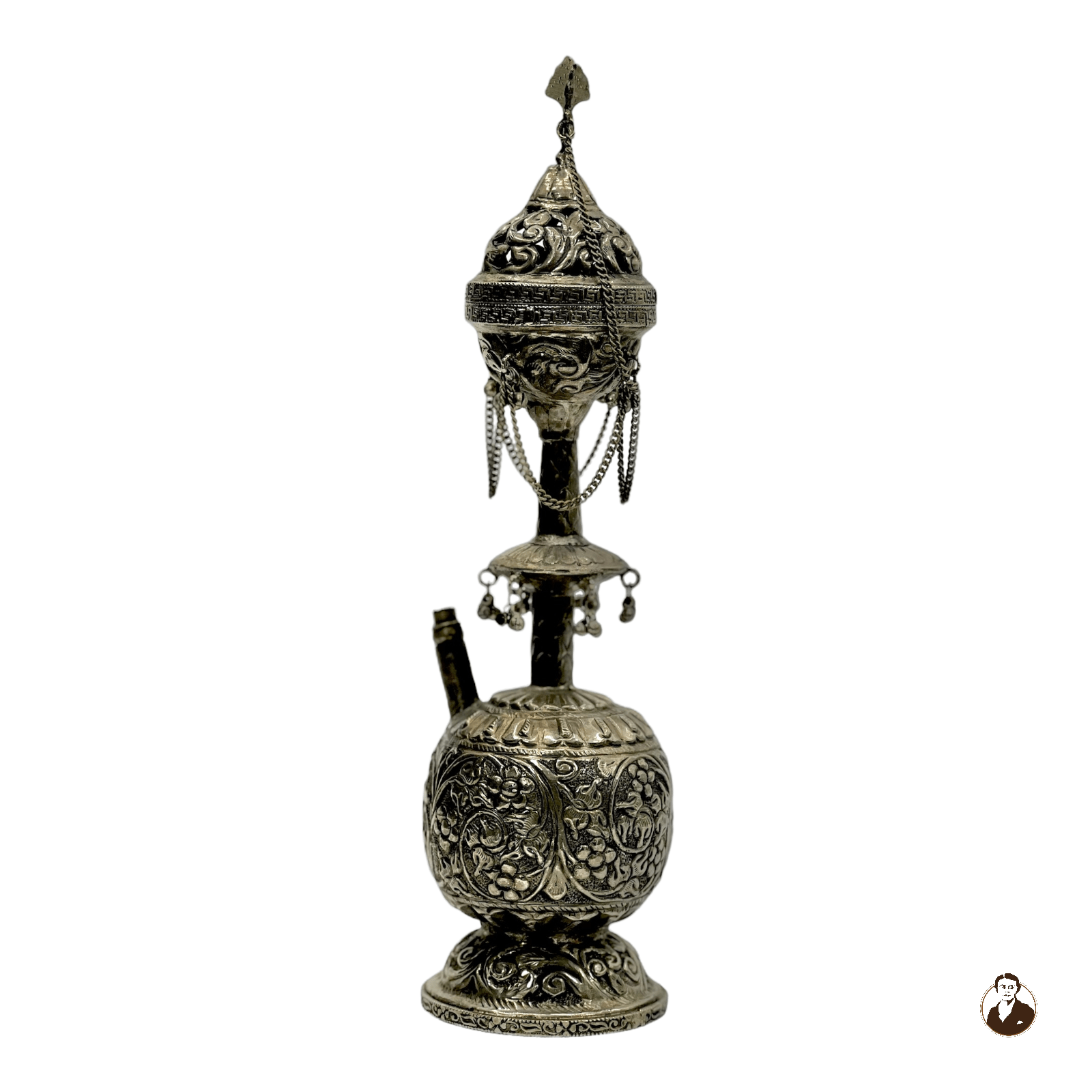
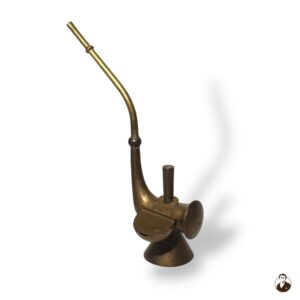
This exceptionally ornate 19th-century Indian hookah combines metalworking, smoking technology, and decorative artistry in a striking vertical form.
Constructed primarily from copper and finished with a substantial silver-plated surface, the hookah is richly covered with scrolling floral ornament, foliage, borders, and repeating decorative motifs. Its densely worked surface transforms what was fundamentally a smoking apparatus into an object of display, craftsmanship, and status.
The vessel rises from a broad decorated foot into a rounded water reservoir, followed by a narrow central stem and an elaborate upper chamber. Suspended chains and small hanging ornaments further animate the silhouette and give the piece a distinctly ceremonial appearance.
Object Details
Date: Circa 1850–1870
Origin: India
Object Type: Hookah / water pipe
Material: Copper with heavy silver plate
Decoration: Floral and scrolling metalwork
Height: Approximately 11.75 in.
Downstem: Original surviving downstem
Condition: Very Good antique condition
Period: Mid-19th century
Metalwork and Decoration
The most immediately striking feature is the density of the surface ornament.
The rounded lower body is divided into decorated panels filled with scrolling vines, flowers, and foliage, while the base, shoulder, stem, and upper chamber continue the same richly worked visual language.
The decoration appears consistent with traditional chased, embossed, or repoussé-style metalworking techniques rather than simple engraved linework.
This layered construction gives the piece considerable depth. Light catches differently across the raised decoration, recessed fields, borders, chains, and projecting fittings, allowing the hookah to read almost like a small piece of architectural metalwork.
Suspended Chains and Pendants
A particularly distinctive element is the use of hanging chains and decorative pendants around the upper portions of the hookah.
These components were not merely functional additions. They contribute to the visual movement and luxury of the piece, creating a more elaborate silhouette than the comparatively restrained forms of many utilitarian water pipes.
The combination of silvered metal, hanging ornaments, and densely patterned surfaces suggests that presentation was an important aspect of the object’s design.
Form and Function
The hookah retains the basic elements required of a traditional water-pipe system.
The rounded lower body functioned as the water reservoir. Smoke would have been drawn downward through the internal downstem, passed through the water chamber, and then inhaled through an attached smoking hose or tube.
The survival of the original downstem is particularly significant because it preserves an important part of the hookah’s original mechanical system.
The visible angled side fitting on the body would have served as part of the smoking-air pathway or hose connection within the larger assembly.
Historical Context
By the 19th century, hookah smoking had become deeply embedded in social life across large parts of South Asia.
Hookahs ranged from relatively simple everyday vessels to elaborately ornamented examples associated with affluent households, formal hospitality, courtly environments, and ceremonial presentation.
Metalworkers produced water pipes in brass, copper, silver, bidriware, and silver-plated metals, often covering them with floral, geometric, and architectural decoration.
This example belongs firmly to the decorative end of that tradition.
Its unusually elaborate profile demonstrates how the hookah could function simultaneously as:
- a smoking device
- an object of metalworking
- a status object
- a decorative furnishing
- a component of social ritual
Indian and Ottoman-Inspired Ornament
The original description refers to Turkish motifs, but I would phrase this more carefully on the museum listing.
The piece certainly displays a decorative vocabulary of arabesques, scrolling foliage, pointed forms, suspended ornament, and floral patterning associated broadly with Islamic decorative arts.
Rather than claiming a specific Turkish origin for individual motifs unless those symbols can be positively identified, I would describe the design as reflecting the broader artistic exchange that connected India, Persia, Central Asia, and the Ottoman world.
That actually makes the description stronger because it recognizes the wider visual culture without over-identifying one motif.
Condition
The hookah remains in very good antique condition for its age.
The copper body retains extensive silver plating, with natural darkening, patina, oxidation, surface variation, and wear consistent with more than a century of age and handling.
The surviving chains, pendants, structural fittings, reservoir, central stem, and original downstem add substantially to the completeness of the piece.
Please review all photographs carefully for the most complete record of condition.
Collector Context
This hookah is particularly relevant to collections focused on:
- Antique hookahs
- Indian decorative arts
- South Asian metalwork
- Islamic decorative arts
- Tobacciana
- Historical smoking implements
- Silver-plated antiques
- 19th-century material culture
- Museum smoking collections
Its combination of scale, heavy ornamentation, surviving functional components, silvered copper construction, and elaborate chain-work makes it considerably more visually ambitious than a standard utilitarian hookah.
Reviews
There are no reviews yet.