
Chinese Bamboo Water Pipe with WWII Veteran Provenance
China, probably early-to-mid 20th century, traditionally dated circa 1940s
This evocative Chinese bamboo water pipe combines regional smoking craftsmanship with an unusually personal wartime provenance.
According to family history, the pipe was brought home from China by an American veteran following service during World War II and remained stored among the veteran’s belongings in an original trunk after his return.
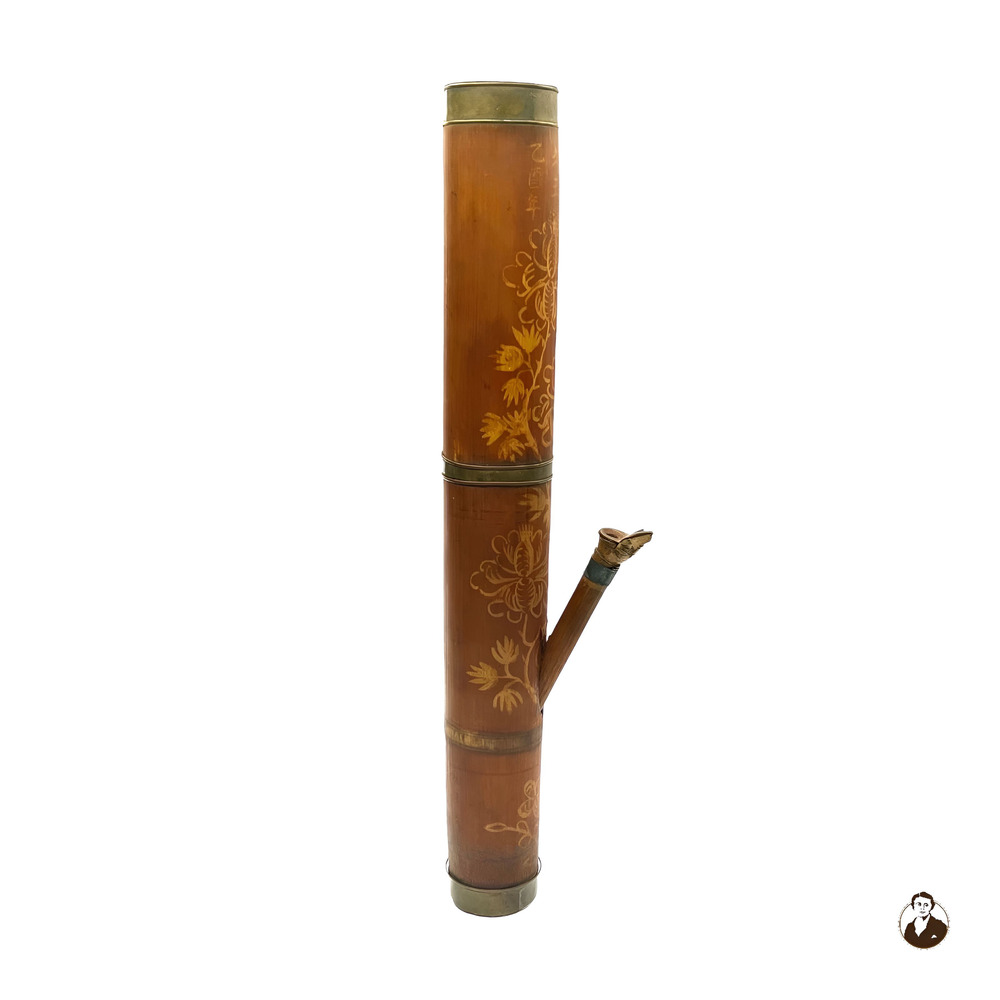
Constructed primarily from bamboo, the pipe takes the form of a tall cylindrical body assembled from multiple fitted sections. Narrow metal collars reinforce the upper rim, base, and principal joints, while a short angled bamboo bowl and downstem project from the lower portion of the body.
Delicate floral decoration appears across the warm amber-toned bamboo surface, giving an otherwise utilitarian smoking implement an understated decorative character.
Object Details
Date: Probably early-to-mid 20th century; traditionally dated circa 1940s
Origin: China
Object Type: Bamboo water pipe
Material: Bamboo with metal reinforcing bands
Decoration: Floral ornament
Bowl / Downstem: Bamboo with metal reinforcement
Provenance: According to family history, brought home from China by an American World War II veteran
Condition: Antique condition with a visible longitudinal split to the bamboo body
Bamboo Construction
The pipe is constructed around the natural cylindrical form of bamboo.
Rather than carving a vessel from a solid block of wood, the maker used bamboo’s naturally hollow structure to create the body of the pipe. Separate sections appear to have been carefully fitted together, with thin metal collars placed around areas particularly vulnerable to splitting and wear.
The construction is simple in appearance but technically efficient.
Bamboo offered several advantages for this type of smoking apparatus:
- Naturally hollow internal structure
- Light weight
- Strong longitudinal grain
- Ease of cutting and fitting
- Availability in many parts of China
- Ability to accept painted or incised decoration
- Compatibility with metal reinforcement
These qualities made it highly suitable for portable and everyday smoking implements.
Floral Decoration
The surface is decorated with delicate floral motifs extending vertically across the bamboo.
The decoration is restrained compared with more elaborate porcelain or silver smoking pipes, but it gives the object a distinctly personal and handcrafted quality.
The warm tone of the aged bamboo, thin metal fittings, and fine floral imagery create a visual balance between utility and decoration.
Water-Pipe Function
The upright bamboo cylinder likely served as the principal reservoir or water chamber.
The angled side assembly appears to incorporate the bowl and downstem, allowing smoke to travel downward into the body before being drawn through the pipe.
Although the exterior strongly supports its identification as a water pipe, the precise original internal airflow cannot be completely reconstructed without direct examination of the interior.
The object is therefore best identified as a Chinese bamboo water pipe, rather than automatically categorizing it as an opium pipe.
Its form is more consistent with a water-smoking apparatus intended for tobacco or another combustible smoking mixture.
World War II Veteran Provenance
The most compelling aspect of this pipe is its reported wartime history.
According to the veteran’s son, the object was brought home from China by his father after World War II service.
The pipe was reportedly preserved among the veteran’s belongings in a trunk that returned home after the war, giving the object a direct family connection to the period.
Because the account is based on oral family provenance rather than currently available military records, photographs, receipts, or written wartime documentation, the most accurate museum wording is:
“According to family provenance, the pipe was brought home from China by an American World War II veteran.”
That phrasing preserves the family’s history without overstating the surviving documentation.
Historical Context
American personnel served across the broader China-Burma-India theater during World War II in aviation, transportation, logistics, medical, communications, and advisory roles.
Objects acquired during overseas service often returned home with servicemen as souvenirs, personal possessions, or reminders of places encountered during deployment.
This pipe belongs naturally within that broader history.
Even without the veteran’s complete service record, the family provenance connects the object to the movement of people and material culture between China and the United States during and immediately after the war.
A Different Kind of Smoking Artifact
Compared with the elaborate porcelain, silver, and enameled smoking objects made for affluent ownership or display, this pipe is much more restrained.
Its materials suggest practicality.
Bamboo, thin metal reinforcement, simple floral decoration, and straightforward construction place the emphasis on function rather than luxury.
That contrast is important.
Smoking history was not composed only of lavish courtly hookahs and decorative pipes. Everyday regional objects such as this one provide equally valuable evidence of how smoking apparatus was made, used, transported, and preserved.
The Longitudinal Split
A visible split runs along part of the bamboo body.
This should be treated as an important condition issue, but not sensationalized as wartime damage.
Bamboo naturally expands, contracts, and can split longitudinally as it loses moisture or experiences changes in humidity over many decades.
The split may reflect:
- Natural aging
- Drying of the bamboo
- Environmental changes
- Long-term storage
- Historical handling
- Impact or use
Without documentation, its exact cause cannot be established.
The damage nevertheless forms part of the object’s physical history and illustrates the vulnerability of organic materials over time.
Condition
The pipe survives in antique condition with visible wear consistent with age and long-term storage.
The bamboo retains its warm aged surface, floral decoration, metal reinforcing bands, and angled bowl/downstem assembly.
A significant longitudinal split is present along the body, along with expected surface wear, discoloration, patina, and age-related variation.
Please review all photographs carefully for the most complete record of condition.
Collector Context
This piece may appeal to collectors of:
- Chinese smoking artifacts
- Bamboo pipes
- Water pipes
- World War II memorabilia
- Veteran bring-back objects
- Chinese material culture
- Tobacciana
- Military-associated provenance
- 20th-century smoking history
- Folk and utilitarian craft
Its significance comes from the combination of traditional bamboo construction, surviving decorative detail, and the family provenance connecting it to an American World War II veteran’s return from China.
Reviews
There are no reviews yet.