
China | c. 1880–1910
This remarkable Chinese water-smoking pipe dates to approximately 1880–1910 and combines late Qing porcelain painting, Daoist symbolism, metalwork, and water-pipe technology within a single highly unusual object.
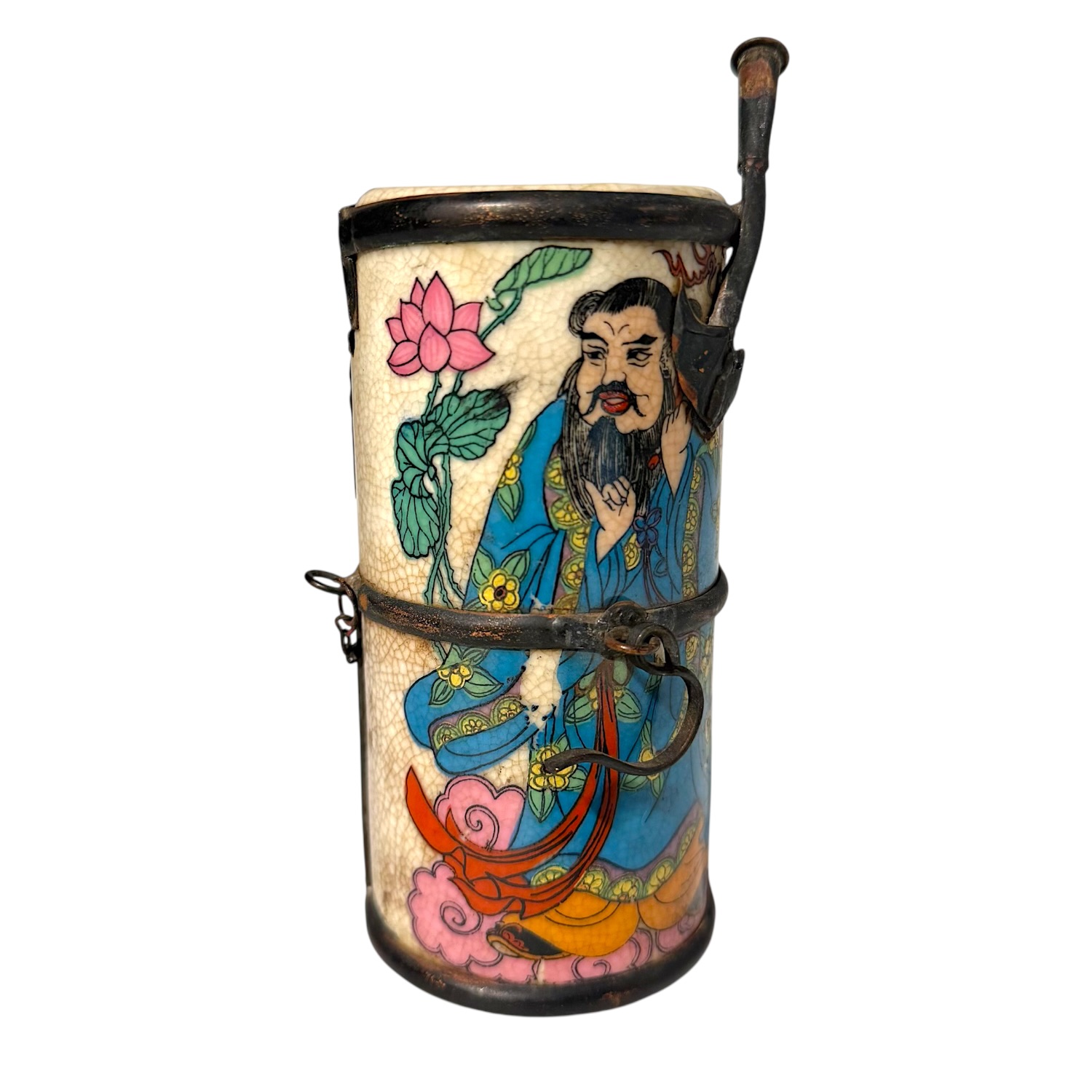
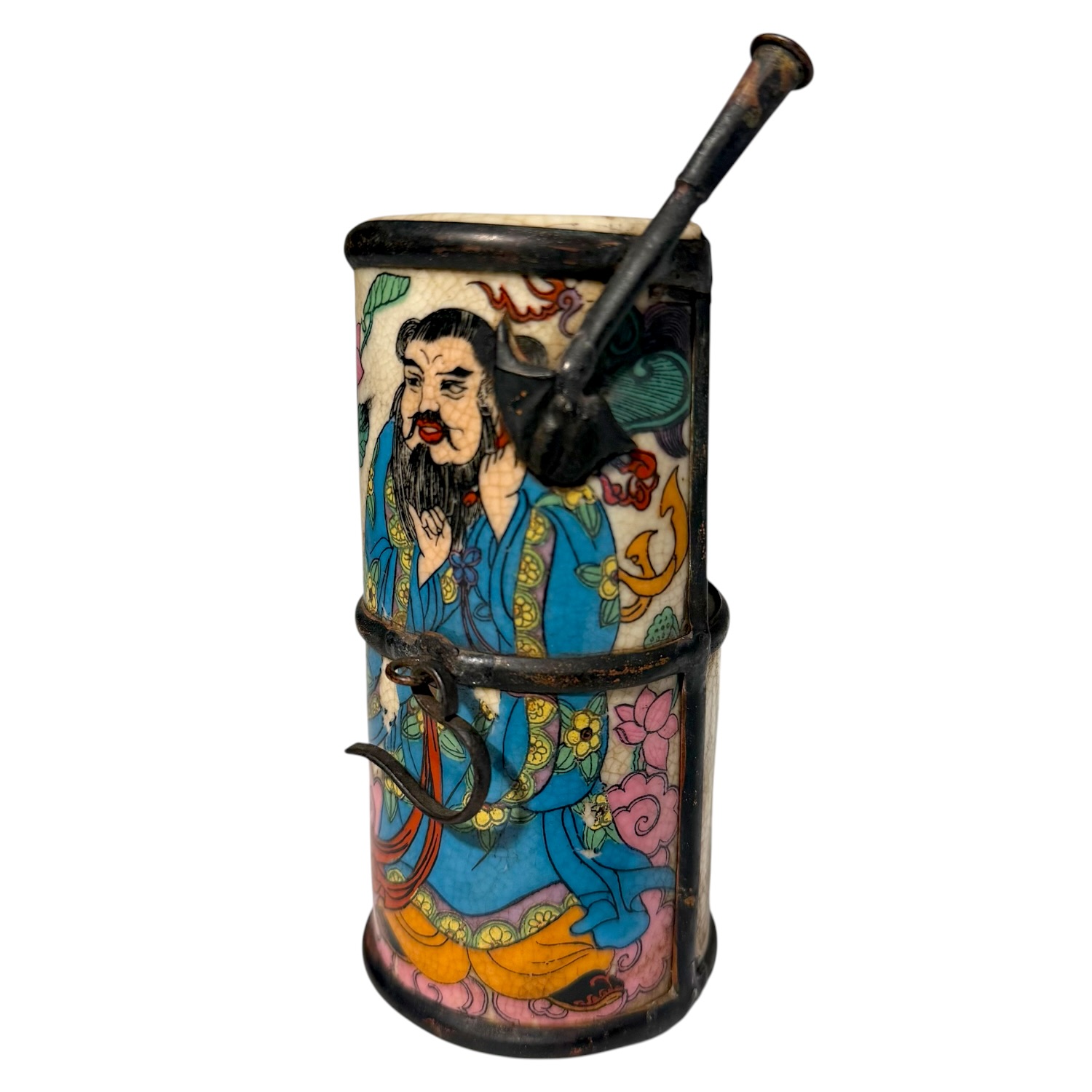
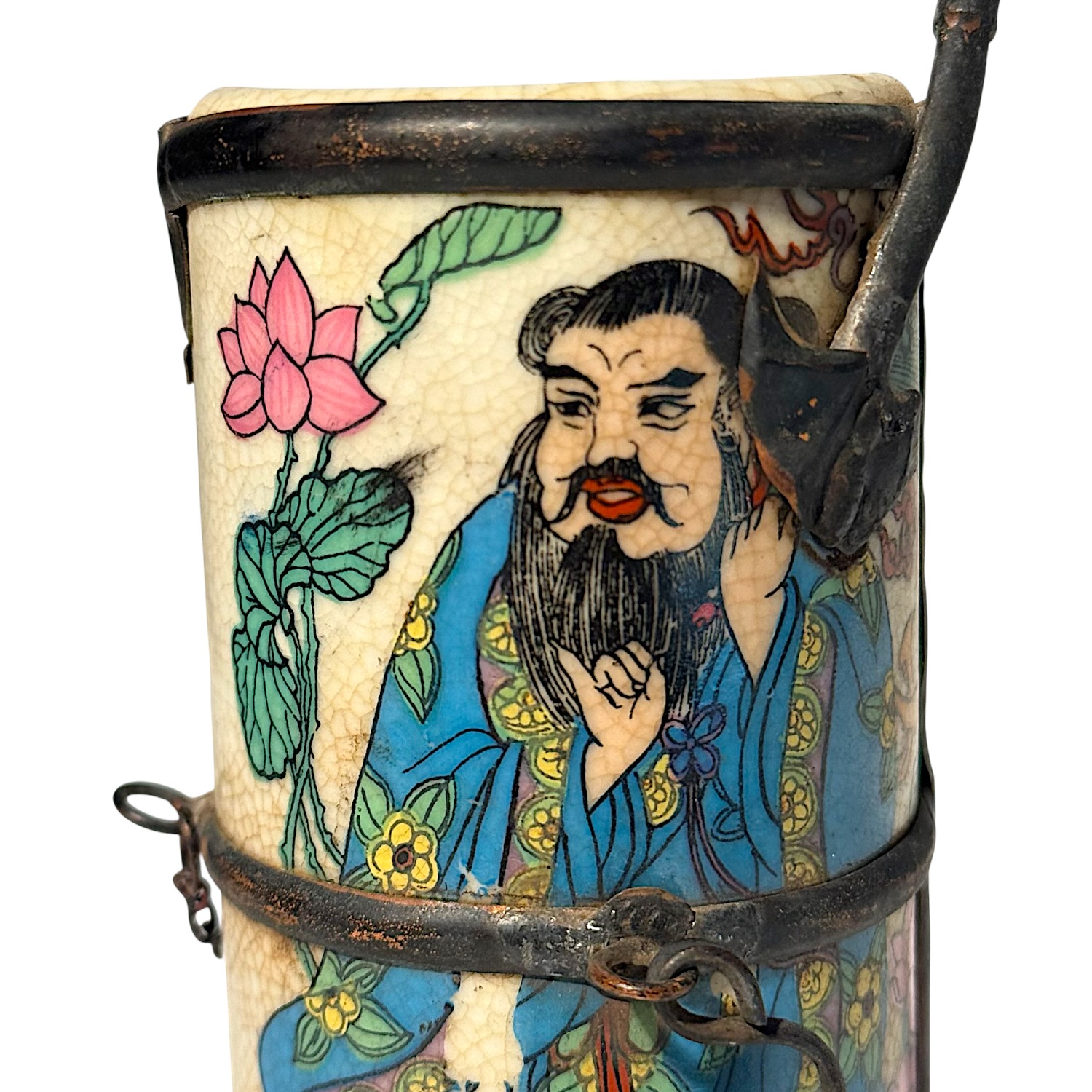
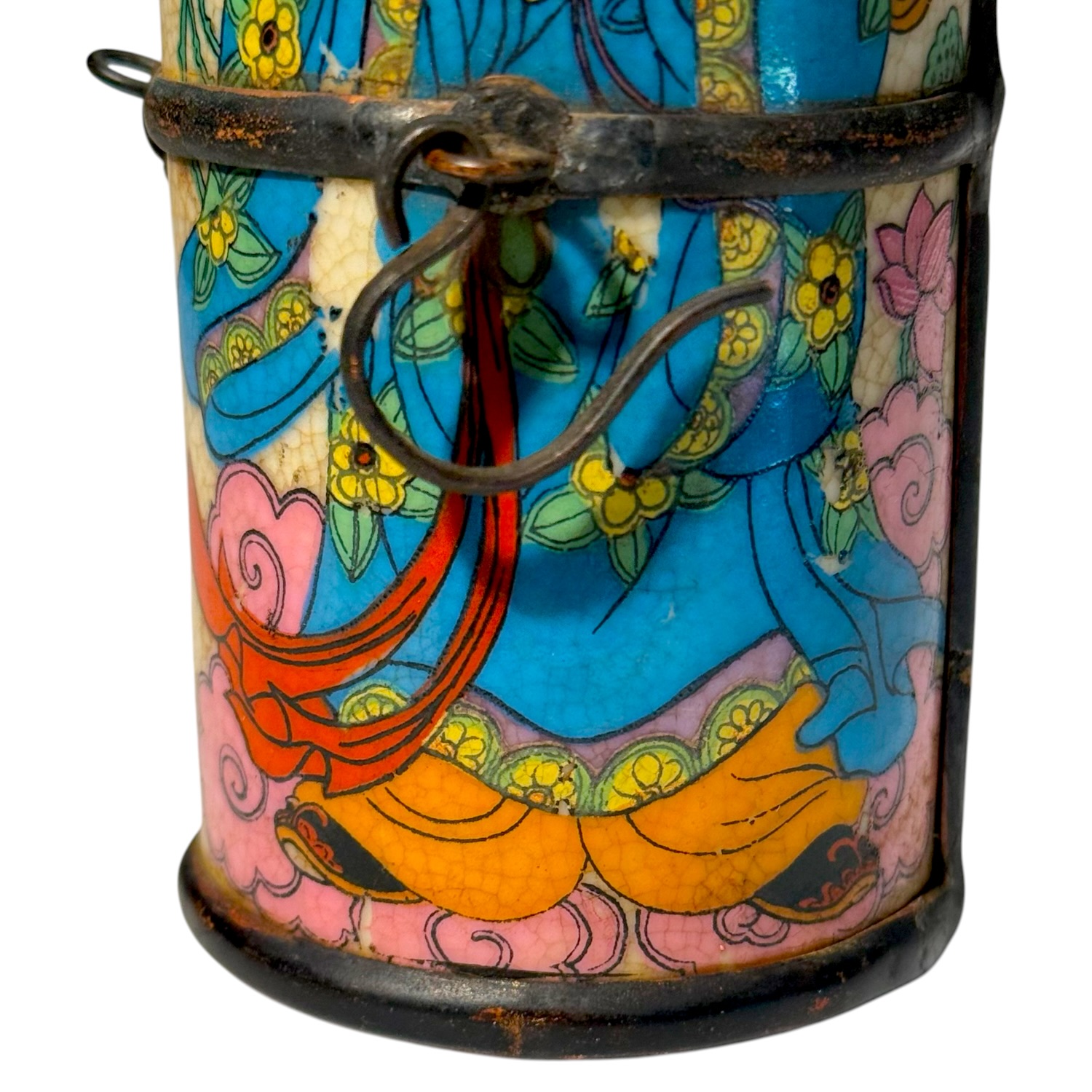
The cylindrical body is formed from cream-colored crackle-glazed porcelain and enclosed within a dark metal framework. Its exterior is dominated by a brilliantly painted image of Zhongli Quan, one of the Eight Immortals of Chinese Daoist tradition.
Dressed in vivid turquoise-blue robes, the heavily bearded immortal appears amid lotus blossoms, celestial clouds, foliage, and scrolling auspicious motifs.
The exceptionally rich palette of turquoise, pink, green, yellow, orange, purple, red, and black makes the pipe one of the most colorful Chinese smoking objects represented within the History of Smoke collection.
Zhongli Quan
Zhongli Quan is one of the legendary Eight Immortals, or Baxian, among the most enduring figures of Daoist religious and popular culture.
He is traditionally depicted as an imposing bearded figure carrying a fan, the attribute visible behind his shoulder on this pipe.
The fan is associated in Daoist legend with extraordinary powers of transformation and revival, making Zhongli Quan an appropriate figure within a broader visual vocabulary concerned with immortality, longevity, and transcendence.
The artist also depicts Zhongli Quan raising one hand beneath his beard in a stylized gesture, further emphasizing his supernatural and sage-like character.
Lotus and Celestial Imagery
A large pink lotus grows alongside the immortal.
Within Chinese visual culture, the lotus became an enduring symbol of purity, spiritual elevation, and transcendence, rising cleanly from muddy water.
Cloud forms beneath and around the figure reinforce his celestial identity. Rather than standing in an ordinary earthly landscape, Zhongli Quan appears surrounded by the visual language of the immortal realm.
Together, the principal motifs create a remarkably coherent symbolic program:
Zhongli Quan: immortality and transformation
Fan: revival and supernatural power
Lotus: purity and transcendence
Clouds: the celestial realm
Floral ornament: abundance and auspiciousness
The smoking pipe therefore carried imagery whose meaning extended far beyond surface decoration.
Painted Porcelain
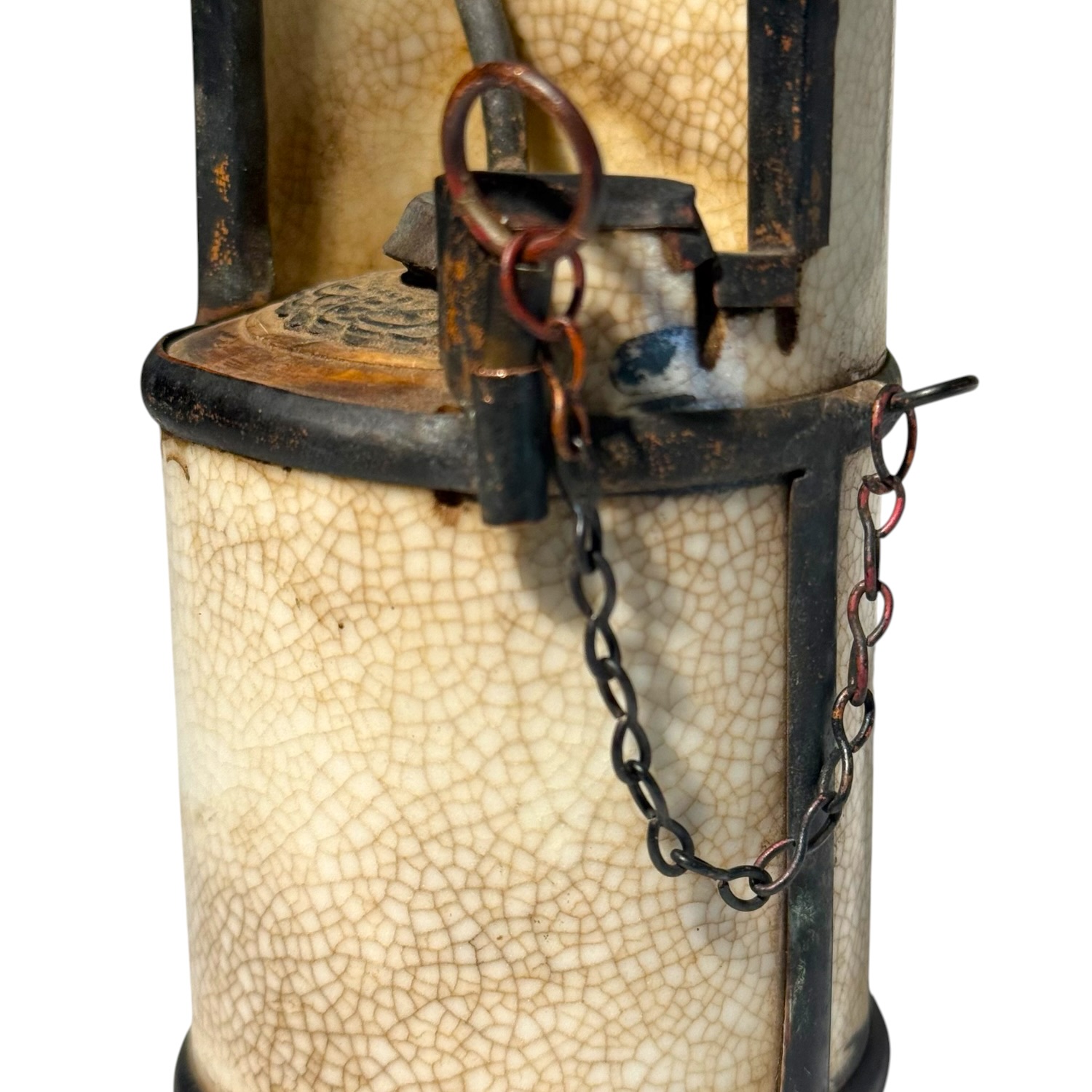
The porcelain body is covered with an intentionally crackled cream glaze.
Over time, sections of the fine craquelure have darkened, creating a network of age-toned lines beneath and around the painted imagery.
The decoration is executed in bright famille rose / fencai-style overglaze enamels.
Close examination shows considerable hand-work within the composition. The immortal’s beard is built from numerous individually varied black strokes. Lotus petals contain separate shading lines, leaf veins change in width and direction, and facial contours display subtle irregularities consistent with brush painting.
The resulting image has a bold and highly graphic character characteristic of commercial late Qing figural porcelain rather than the restrained formalism of imperial court wares.
The Water-Smoking System
The vessel itself is not simply decorative.
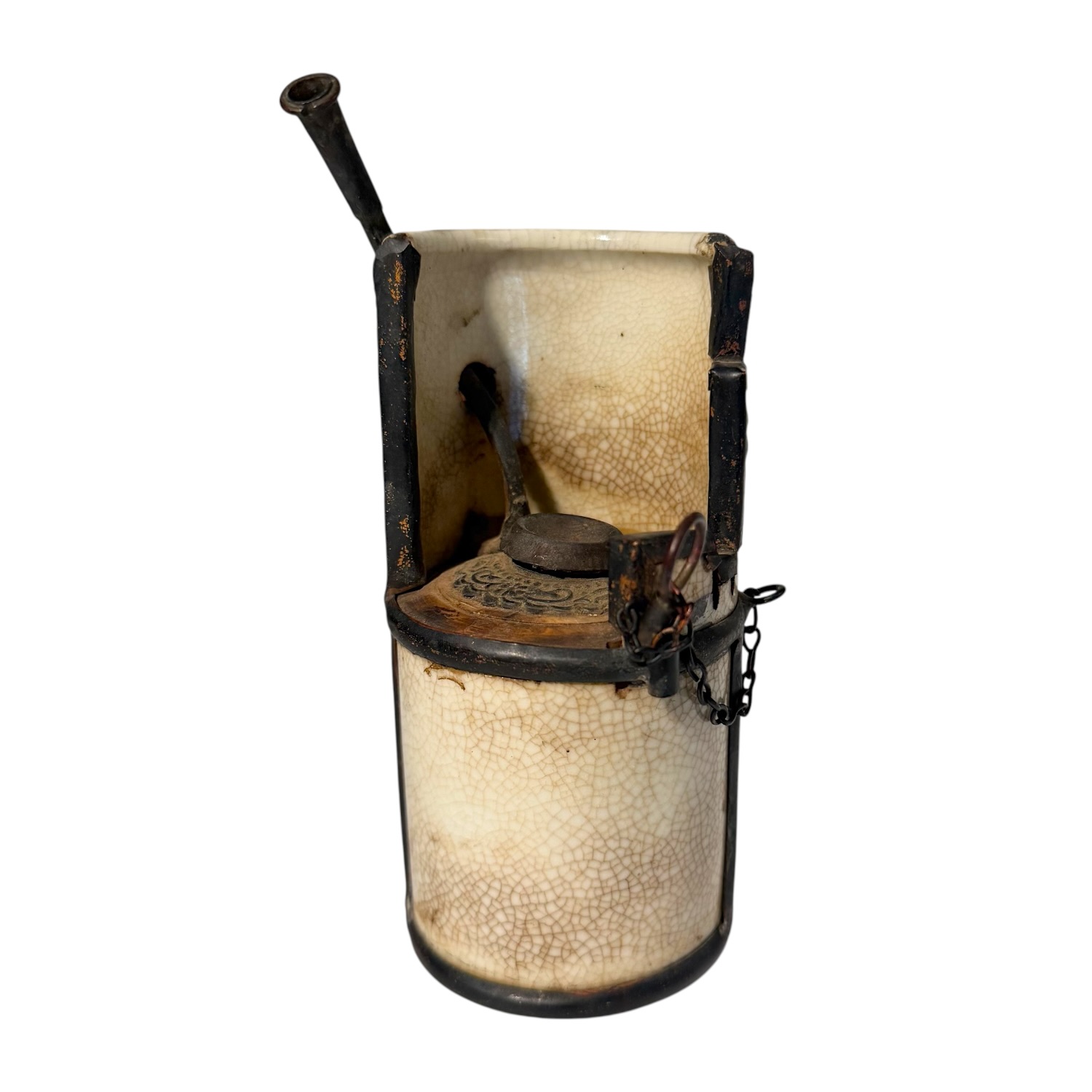
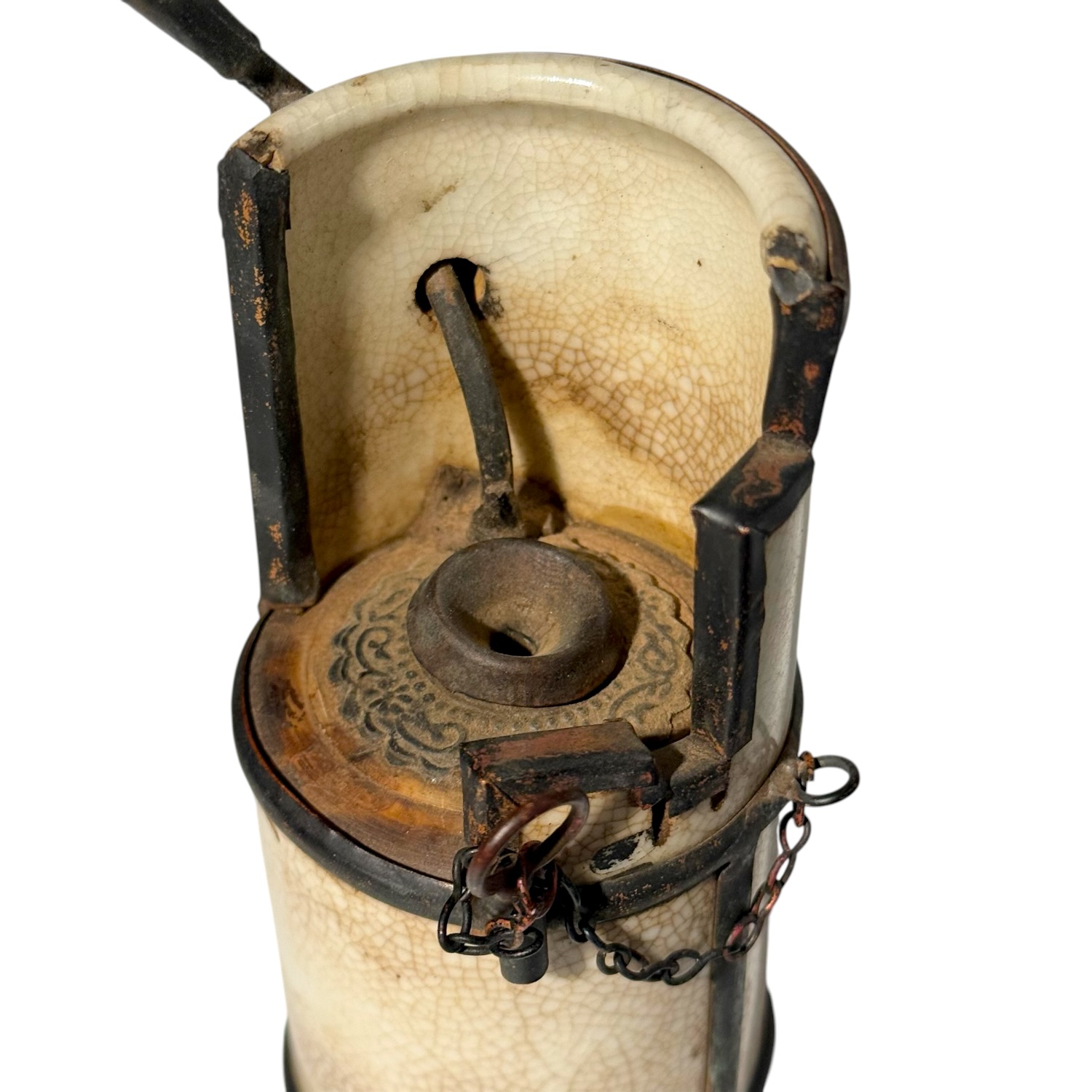
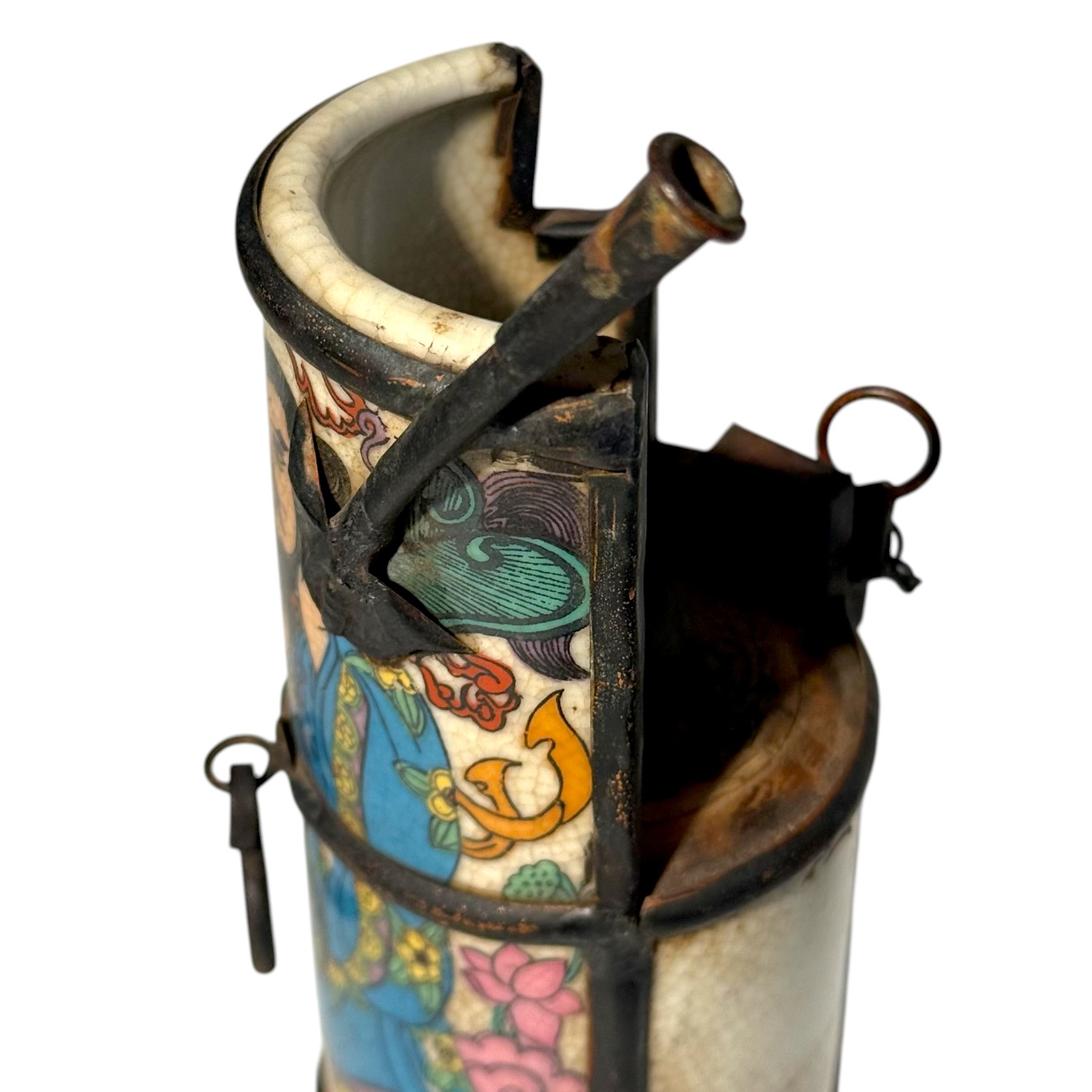
Its porcelain body forms a water reservoir, while an internal platform supports the smoking chamber and downstem. Smoke would have been drawn downward through the system, passed through water inside the reservoir, and then inhaled through the elongated metal tube.
The surviving mechanism includes the smoking bowl, internal downstem, mouthpiece, exterior metal bands, supporting framework, rings, chain, and associated fittings.
Darkening, residue, staining, and oxidation remain visible within protected areas of the interior and around the smoking assembly.
Chinese and Southeast Asian water pipes of this family were historically associated primarily with tobacco smoking, although period museum terminology also records examples as opium or tobacco water pipes. The exact substance smoked in this particular pipe cannot be established without residue analysis.
Qianlong Seal Mark
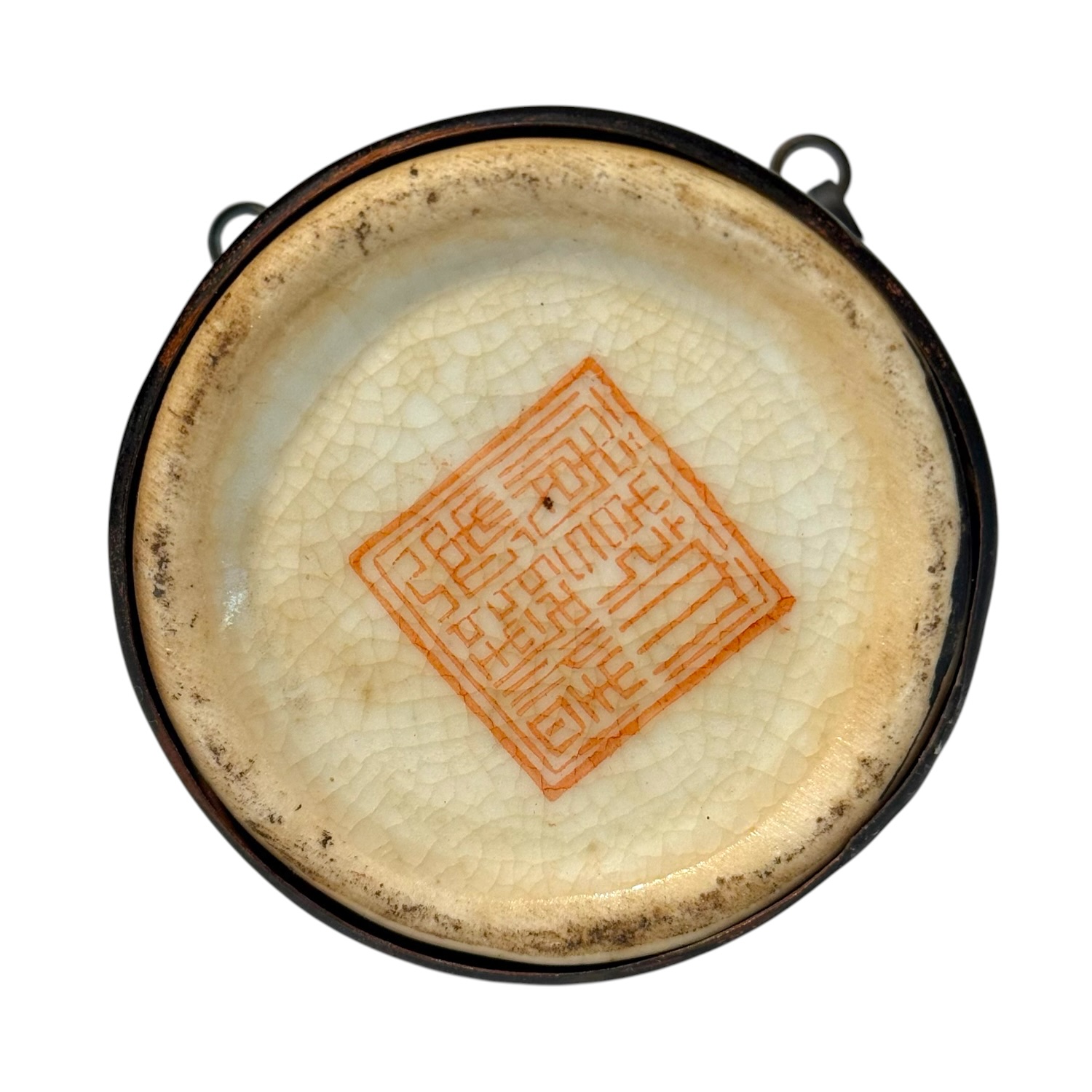
The base carries an iron-red six-character seal mark reading:
大清乾隆年製
or:
Da Qing Qianlong Nian Zhi
“Made during the Qianlong reign of the Great Qing.”
The pipe itself does not appear to date from the Qianlong reign.
Instead, this is an apocryphal Qianlong mark, one of the many later reign marks placed on Chinese ceramics in admiration of earlier periods.
Its presence provides another fascinating link between the object and China’s long tradition of referencing prestigious earlier dynastic styles.
Historical Context
By the 19th century, water smoking had developed into a sophisticated material culture across China and Southeast Asia.
Water pipes were produced from brass, copper, bamboo, wood, porcelain, and combinations of several materials. Some were purely practical. Others became highly decorative objects whose painted surfaces reflected the religious symbols, auspicious imagery, and artistic tastes of their owners.
Porcelain was particularly suited to this transformation.
Its surface could carry landscapes, calligraphy, immortals, flowers, mythological figures, and religious symbolism while simultaneously forming the reservoir of the smoking apparatus.
This pipe represents an especially dramatic expression of that tradition.
Dating
The combined evidence presently supports a date in the late Qing to early Republic period, approximately:
c. 1880–1910
The Chinese porcelain and iconography are clear, although its structural relationship to water pipes produced for Vietnam and other Southeast Asian markets leaves open the possibility that it was manufactured in China specifically for export within that regional smoking culture.
Object Details
Date: c. 1880–1910
Origin: China
Period: Late Qing to Early Republic
Object Type: Water-smoking pipe
Materials: Porcelain and metal
Glaze: Cream crackle glaze
Decoration: Polychrome famille rose / fencai-style overglaze enamels
Subject: Zhongli Quan
Tradition: Daoist Eight Immortals
Motifs: Lotus blossoms, clouds, foliage, and auspicious ornament
Mark: Apocryphal Qianlong six-character seal mark in iron-red
Smoking System: Water reservoir, smoking chamber, downstem, and inhalation tube
Condition: Very good antique condition with natural craquelure, surface wear, metal oxidation, staining, and evidence of historic use
Collector Context
Among surviving Chinese water pipes, this example is particularly notable for the extraordinary richness of its painted decoration.
Rather than relying primarily on blue-and-white ornament or simple geometric pattern, nearly the entire visible front of the vessel becomes a polychrome portrait of a Daoist immortal.
Its combination of smoking technology, brilliantly colored late Qing porcelain, religious iconography, symbolic imagery, and surviving metal apparatus makes it an especially significant object for collections focused on Chinese smoking culture, historic water pipes, Daoist art, Asian porcelain, and the global history of smoke.
Reviews
There are no reviews yet.