
Women, Tobacco, and Enamel Art in Nineteenth-Century Iran
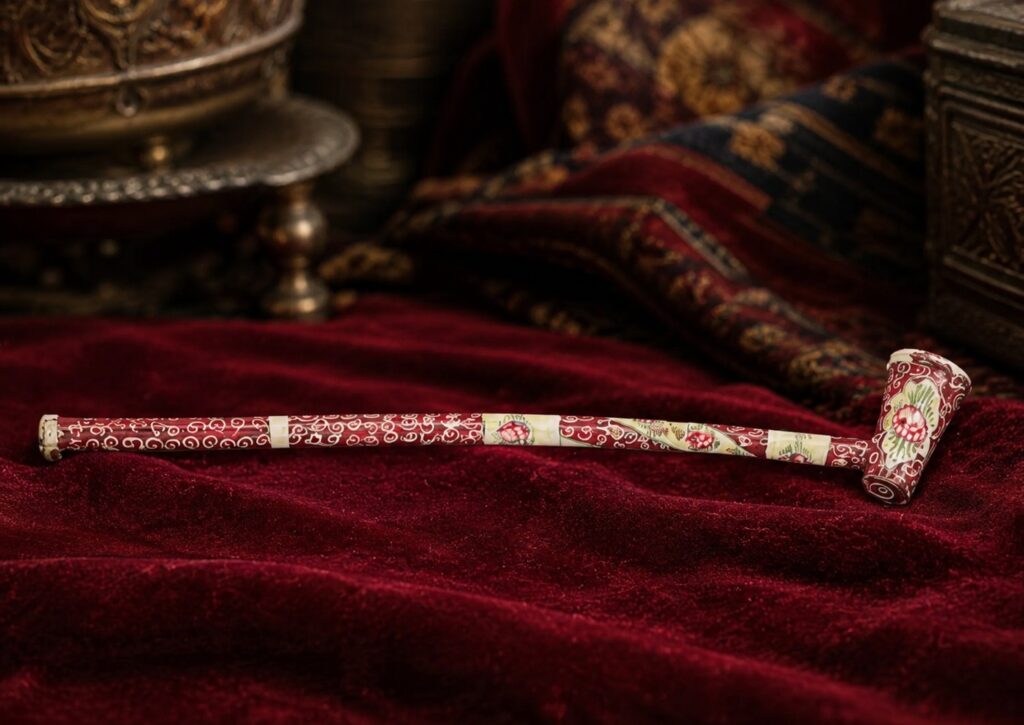
Traditionally identified as a Persian woman’s dokha pipe, this miniature copper-and-enamel object opens a remarkable window onto private smoking rituals, luxury craftsmanship, gender, and the politics of tobacco under the Qajar dynasty.
Object Record
Object: Miniature dry-tobacco pipe
Attributed origin: Persia, present-day Iran
Period: Qajar era
Provisional date: Circa 1850–1890
Materials: Copper or copper alloy with polychrome enamel decoration
Length: Approximately 5 inches
Traditional identification: Persian woman’s dokha pipe
Condition: Very good antique condition, with localized enamel wear consistent with age and handling
Collection: History of Smoke Museum
At only five inches long, this delicate pipe appears almost too small to be functional.
Its narrow stem curves gently toward a tiny flared bowl. Deep red enamel covers much of the metal surface, interrupted by cream-colored bands, miniature floral medallions, white scrolling vines, and touches of pale green, yellow, and pink. Every decorative element has been compressed into an object that could rest almost invisibly within the hand.
The pipe is traditionally described as a nineteenth-century Persian woman’s dokha pipe, made from copper and ornamented with finely painted enamel. That identification is historically plausible—but it also requires careful qualification.
The object is unquestionably connected to the world of Persian tobacco smoking and Qajar decorative art. Its exact original tobacco, owner, workshop, and intended gender, however, cannot be proven from appearance alone.
Its most responsible museum identification is:
Qajar Persian polychrome enamel-on-copper miniature tobacco pipe, circa 1850–1890, traditionally attributed as a woman’s pipe and possibly connected to the short-pipe traditions of southern Persia and the Persian Gulf.
That careful wording does not diminish the pipe. It reveals why the object is so fascinating: it stands at the intersection of several overlapping histories that are rarely preserved in a single artifact.
Tobacco Arrives in Persia
Tobacco was not native to Iran.
It reached Persia near the end of the sixteenth century, probably through Portuguese, Ottoman, Indian, and European commercial networks. Although Shah ʿAbbās I attempted to suppress smoking, tobacco quickly became embedded in Persian life. Cultivation was already documented in Hamadan by 1617, and seventeenth-century observers reported that the plant was soon being grown throughout much of the country.
Persians did not simply adopt a foreign commodity without changing it. Tobacco was absorbed into local agriculture, hospitality, craft production, social etiquette, and regional taste.
Two smoking systems became especially important.
The qalyān passed tobacco smoke through water before inhalation. It could be a hand-held vessel or a larger standing apparatus equipped with a long tube or hose.
The čopoq was a dry pipe with a small bowl and a wooden stem. Some examples were exceptionally long, while more portable versions used shorter stems. Wealthy owners could commission pipes made from precious materials, while ordinary smokers used wood, clay, or other inexpensive substances.
By the end of the nineteenth century, Persian tobacco was divided into several recognizable categories. Tambāku was associated primarily with water pipes, while tūtūn-e čopoq was used in dry pipes, including the short, one-piece pipe known as a sebilu. Cigarette tobacco entered cultivation later in the century.
The miniature pipe in the History of Smoke Museum belongs to the dry-pipe side of this larger culture.
How the Miniature Pipe Probably Worked
The object has no water reservoir, hose fitting, separate bottle, or internal chamber large enough to function as a qalyān.
Instead, the user would have placed a very small quantity of dry tobacco directly inside its flared bowl. The tobacco was then ignited, and smoke traveled through the narrow metal stem to the mouthpiece.
Its unusually small bowl suggests a brief smoking session rather than the extended ritual associated with a large water pipe. A single filling may have produced only a few concentrated draws.
The scale also made the pipe exceptionally portable. It required no water, charcoal arrangement, separate hose, or servant to assemble it. The owner needed only tobacco and a source of ignition.
Because its bowl and airway are so narrow, cleaning would have been essential. A thin pick, wire, or needle may have been used to remove ash and residue from the passage.
The entire experience would have been intimate and controlled: a small amount of tobacco, a small object, and a short moment of use.
Was It Really a Dokha Pipe?
The pipe closely resembles the basic principle of the modern midwakh, the small pipe used to smoke dokha in the Arabian and Persian Gulf region.
Dokha is generally prepared as a dry, finely processed tobacco and smoked in small quantities. Contemporary research identifies the midwakh as a compact pipe whose small bowl can be consumed in only a few inhalations.
The five-inch length, thin stem, and tiny bowl of the museum pipe are all compatible with that method of smoking.
The historical terminology is less certain.
Nineteenth-century Persian sources distinguish among tambāku, čopoq tobacco, cigarette tobacco, and regional preparations. They do not consistently identify small Persian pipes using the exact modern commercial pairing of “dokha” and “midwakh.”
It is therefore reasonable to describe the artifact as dokha-related or as part of the broader Persian Gulf short-pipe tradition, but it would be too definitive to claim that dokha was the only substance ever placed in its bowl.
A more historically precise statement is:
The pipe was designed for a small quantity of strong dry tobacco, potentially similar to the tobacco traditions now associated with dokha and the midwakh.
A Pipe Made into a Jewel
A plain pipe of this size could have been produced from clay, wood, bone, brass, or undecorated copper.
This example is different.
Its metal surface was transformed through elaborate polychrome decoration. Fine white scrolls move across a burgundy-red field. Floral roundels divide the stem into decorative registers. Cream-colored bands create rhythm along its length, while the bowl carries a larger concentration of ornament.
The visual language is strongly compatible with Qajar decorative art.
Qajar artists were known for intense color, meticulous detail, floral imagery, portrait medallions, and the adaptation of similar painting techniques across lacquer, tilework, jewelry, and enamel over gold or copper. Roses, irises, foliage, and fruit were especially prominent motifs.
Enamelwork was also directly connected with smoking culture. Surviving nineteenth-century qalyān components include copper forms finely painted with floral sprays, figures, portraits, and colorful cartouches. One documented mid-nineteenth-century example consists of a gilt-copper qalyān element painted in enamel with women, children, and flowers.
The museum pipe is far smaller than those elaborate water-pipe components, but it belongs to the same broad world of decorated smoking equipment.
Its surface converts an ordinary implement into a personal luxury object.
The Art of Enamel on Copper
The pipe is catalogued as copper with painted enamel, though a physical examination would be required to determine the exact alloy and decorative process.
Traditional enamel decoration involves applying a glass-based material or enamel pigment to metal and stabilizing it through heat. More detailed designs may require multiple applications and firings because different pigments react at different temperatures.
On a five-inch curved pipe, the process would have been especially demanding.
The decorator had to maintain repeated borders around a surface only a fraction of an inch wide. Floral motifs had to remain legible despite the stem’s curvature. The junction between the stem and bowl created another difficult surface, while the bowl itself had to withstand heat from burning tobacco.
The resulting object was functional, but its visual effect was closer to jewelry, a painted box, or a miniature court accessory.
The decoration may also have helped communicate ownership. A pipe handled in company was visible at close range. Its materials and finish could indicate refinement, taste, wealth, or participation in fashionable urban culture.
Was It Made Specifically for a Woman?
The pipe’s small size, elegant curvature, and floral decoration have encouraged its traditional identification as a woman’s pipe.
That interpretation is plausible.
Tobacco smoking in Persia was not exclusively male. Encyclopaedia Iranica describes the pipe and water pipe as deeply integrated into the lives of both Persian men and women. Smoking took place in homes as well as coffeehouses and other public or social environments.
Qajar visual culture provides direct evidence of women smoking.
A large nineteenth-century painting now associated with the Royal Ontario Museum depicts women and children gathered in the andarun, the private female quarters of a prosperous home. One of the principal women holds and smokes a qalyān while surrounded by textiles, fruit, music, tea, children, attendants, and imported household goods.
The scene is important because it places smoking within domestic female sociability rather than treating it as an exclusively public male activity.
A petite pipe would have been easier to hold, carry, store, and use privately than a long čopoq or fully assembled qalyān. Its floral enamel and jewel-like appearance would also have suited the highly decorated material environment of an affluent Qajar household.
None of this proves that the original owner was a woman. Men also used portable pipes and owned objects ornamented with flowers. Without a documented owner, inscription, fitted original case, or reliable chain of provenance, gender cannot be established from decoration alone.
The best museum language is therefore:
Traditionally attributed as a woman’s pipe; female domestic ownership is plausible but unconfirmed.
Reconstructing Its Original Setting
Imagine an urban Persian residence during the reign of Nāṣer-al-Dīn Shah, who ruled from 1848 to 1896.
Beyond the public rooms lies the andarun, the private domestic space associated with the household’s women and children. The room opens toward a courtyard or balcony. Painted walls, carved wood, carpets, cushions, brass vessels, mirrored decoration, and patterned textiles surround the occupants.
Tea is poured from a pot warmed beside a samovar. Fruit and sweets rest on shallow dishes. Conversation moves between family affairs, court news, poetry, clothing, marriage arrangements, local gossip, and household business.
The miniature pipe is removed from a small box or textile wrapping. A pinch of tobacco is placed in the bowl and touched with a flame or glowing ember. The smoker raises the slender stem to her lips and takes a brief draw.
Only a small thread of smoke rises.
Unlike the qalyān, the pipe needs no servant, water bottle, hose, or prolonged preparation. It can be used and put away within minutes.
This scene is a historically informed reconstruction, not a documented account of the artifact’s original owner. Its purpose is to show how a refined portable pipe could have functioned within the private domestic world depicted in Qajar paintings and photographs.
Tobacco as Hospitality and Status
Smoking in Qajar Persia was more than nicotine consumption.
A prepared pipe could be offered to a guest alongside tea or coffee. Important figures employed servants whose responsibilities included carrying, assembling, and presenting smoking equipment. Itinerant sellers also supplied ready-to-use water pipes to customers who did not own their own elaborate apparatus.
The quality of a pipe helped communicate social position.
An ordinary smoker might use a simple clay bowl and wooden stem. A prosperous owner could commission silver, gold, enamel, jewels, turquoise, fine wood, or imported glass.
The museum pipe is not monumental or extravagantly jeweled, but its painted enamel required additional labor beyond basic manufacture. It was designed to be observed closely and handled carefully.
Its luxury lies in miniaturization.
The owner carried not simply a tool, but a pocket-sized display of color, craft, and identity.
A Small Pipe and a National Political Crisis
The pipe’s proposed date of 1850–1890 places it near one of the most consequential political events in modern Iranian history: the Tobacco Protest of 1890–1892.
In 1890, Nāṣer-al-Dīn Shah granted a British concession extensive control over the production, sale, and export of Persian tobacco. Merchants, religious leaders, consumers, and political critics viewed the arrangement as a threat to domestic livelihoods and national sovereignty.
A religious prohibition against tobacco use helped transform economic opposition into a mass boycott.
The response revealed how thoroughly tobacco had entered Persian life. People temporarily abandoned a custom practiced across classes and genders. Even women within the royal harem reportedly joined the boycott and refused to smoke, to the frustration of the shah.
The concession was eventually withdrawn.
This episode transformed the meaning of smoking equipment. A qalyān, čopoq, or miniature dry pipe was no longer merely a personal object. For a brief but historic moment, choosing not to use it became an act of resistance.
Royal women’s participation is especially significant. Their refusal to smoke demonstrates both the normal presence of tobacco in female life and women’s capacity to influence political events from within spaces often dismissed as secluded or powerless.
A pipe like this could therefore exist simultaneously as an ornament, a source of pleasure, a domestic possession, and—under extraordinary circumstances—a symbol of political choice.
Reading the Wear
The visible condition of the pipe is consistent with an object that has survived significant handling.
Small areas of enamel loss appear along the narrow stem and near its ends. The mouthpiece shows wear, while the rim of the bowl appears rubbed and irregular. Where decoration has been lost, the underlying metal is exposed.
Such wear should not automatically be treated as a defect.
On a smoking object, the most vulnerable areas are precisely those touched repeatedly: the mouthpiece, the bowl rim, the stem where fingers rested, and the connections between components. Heat, moisture, tobacco residue, cleaning, and storage could all affect the surface.
Close examination of the bowl interior may reveal carbonized residue. If genuinely old and embedded, such residue would support historical use, although it could not identify the exact tobacco smoked.
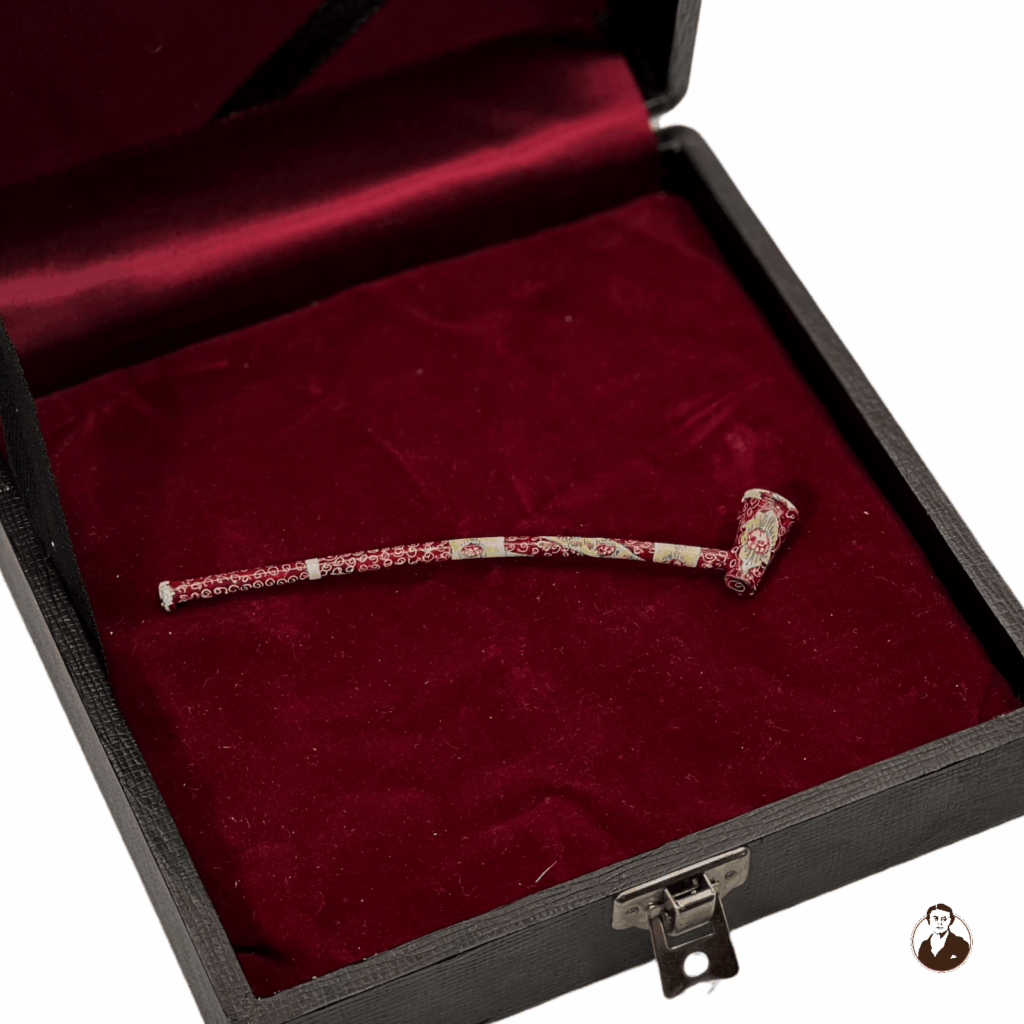
The red velvet presentation box visible in existing photography appears much larger than the pipe and does not have an object-specific fitted recess. Unless documentary provenance establishes otherwise, it should be treated as a later storage or display case rather than confidently described as the original nineteenth-century case.
Dating the Pipe Responsibly
The proposed date of circa 1850–1890 is reasonable but remains an attribution.
Its Qajar character is supported by:
- the polychrome enamel decoration
- the floral and scrolling vocabulary
- the likely copper substrate
- the emphasis on minute painted detail
- the broader Qajar tradition of decorating smoking implements
- the object’s compatibility with nineteenth-century dry-pipe culture
However, Qajar styles continued into the early twentieth century, and decorative objects were sometimes produced in older forms.
A firmer attribution would require physical examination.
Non-destructive X-ray fluorescence analysis could help determine whether the metal is copper, brass, silvered copper, or another alloy. Magnification could clarify whether the decoration is fired enamel, cold-painted enamel, lacquer, or a combination of techniques. Examination of seams could reveal how the stem and bowl were manufactured and assembled.
Until such testing occurs, the date should be presented as circa 1850–1890, not as an exact year.
Why This Pipe Matters
The significance of this object is not based solely on rarity or beauty.
It preserves several histories at once.
It represents the transformation of tobacco from a foreign plant into a deeply Persian social practice. Demonstrating how Qajar craftsmen elevated smoking equipment through color, floral imagery, and miniature painting. It offers evidence of a compact dry-pipe tradition that existed alongside the far better-known qalyān.
It also invites a more nuanced understanding of gender.
The traditional description of the object as a woman’s pipe cannot be proven, but neither should women be erased from its history. Women smoked in Qajar homes, appeared with pipes in contemporary art, and participated dramatically in the tobacco boycott.
Finally, the pipe reminds us that historical smoking culture was never represented by a single universal object.
The qalyān belonged to one kind of ritual. The long čopoq belonged to another. Cigarettes gradually introduced a new form of portability and speed. This five-inch pipe occupied its own intimate territory: small, personal, quickly prepared, and richly decorated.
It could disappear into the hand, but it carried an entire world upon its surface.
Museum Catalogue Entry
Qajar Persian Polychrome Enamel-on-Copper Miniature Tobacco Pipe
Persia, circa 1850–1890. Copper or copper alloy with painted polychrome enamel decoration. Approximately 5 inches long.
A slender, slightly curved dry-tobacco pipe terminating in a small angled bowl. The pipe is decorated with white scrolling ornament and floral medallions over a deep red ground, divided by narrow cream-colored bands. Traditionally identified as a Persian woman’s dokha pipe, its small capacity and portable construction are compatible with the short-pipe traditions of southern Persia and the Persian Gulf, although the precise tobacco used and the gender of its original owner remain unconfirmed.
The object reflects the integration of tobacco into Qajar domestic life and the period’s sophisticated tradition of enamel decoration over copper. Its intimate scale, elaborate surface, and signs of historical handling distinguish it as both a functional smoking implement and a miniature work of Persian decorative art.
History of Smoke Museum Collection