
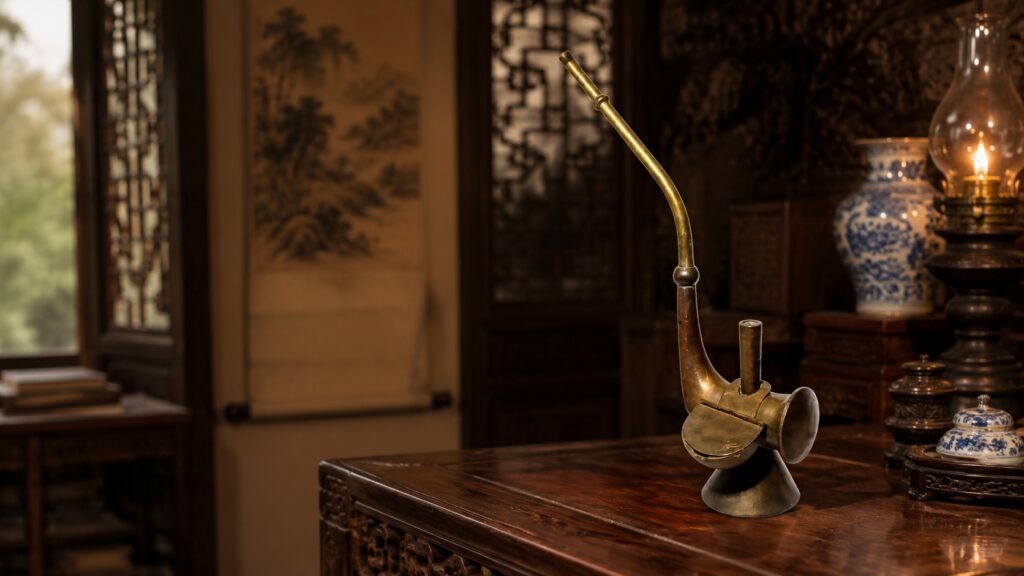
Often mislabeled as an opium pipe, this compact brass vessel was an ingenious tobacco-smoking system and a revealing artifact of everyday life in late imperial China.
Object: Chinese brass water-tobacco pipe
Origin: China
Period: Late Qing Dynasty
Provisional date: Circa 1880–1900
Material: Brass
Height: Approximately 12 inches
Collection: History of Smoke Museum / Goodson Gallery
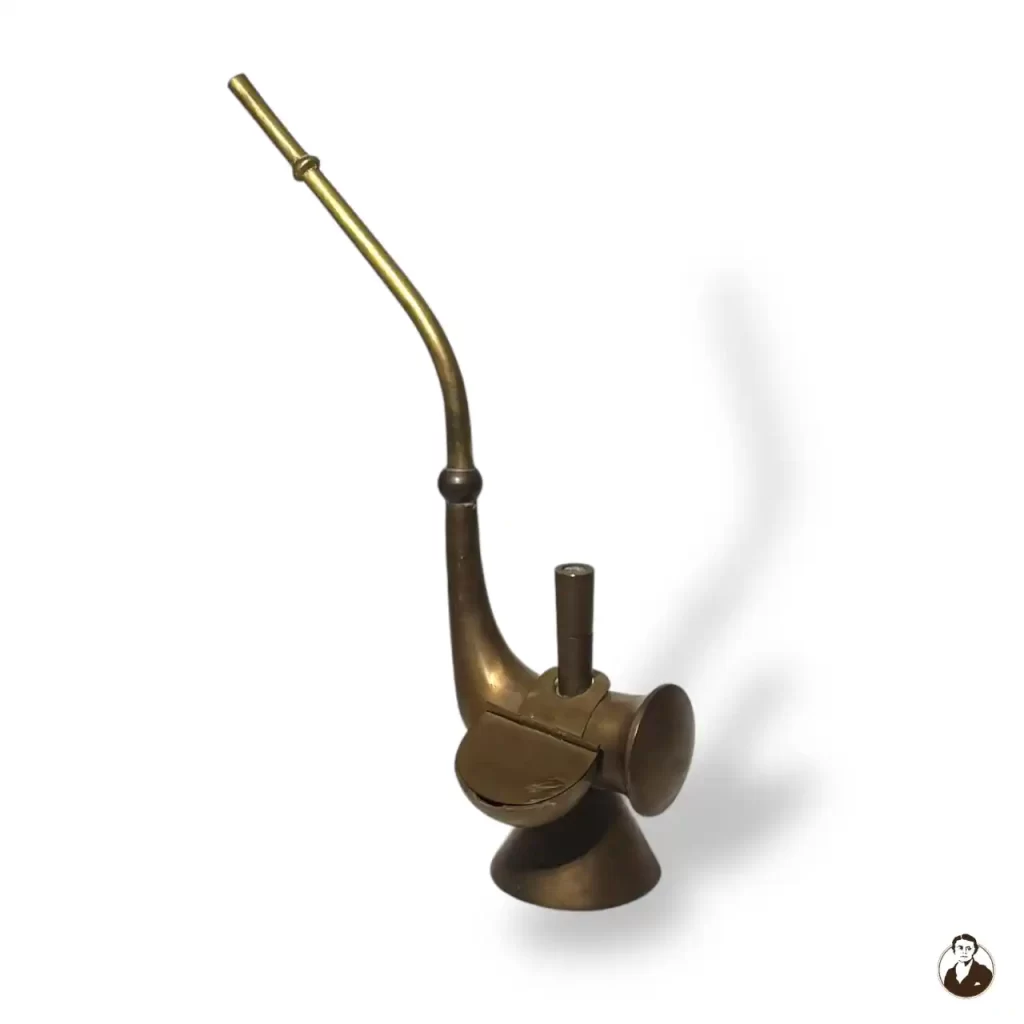
At first glance, this unusual brass object is difficult to understand.
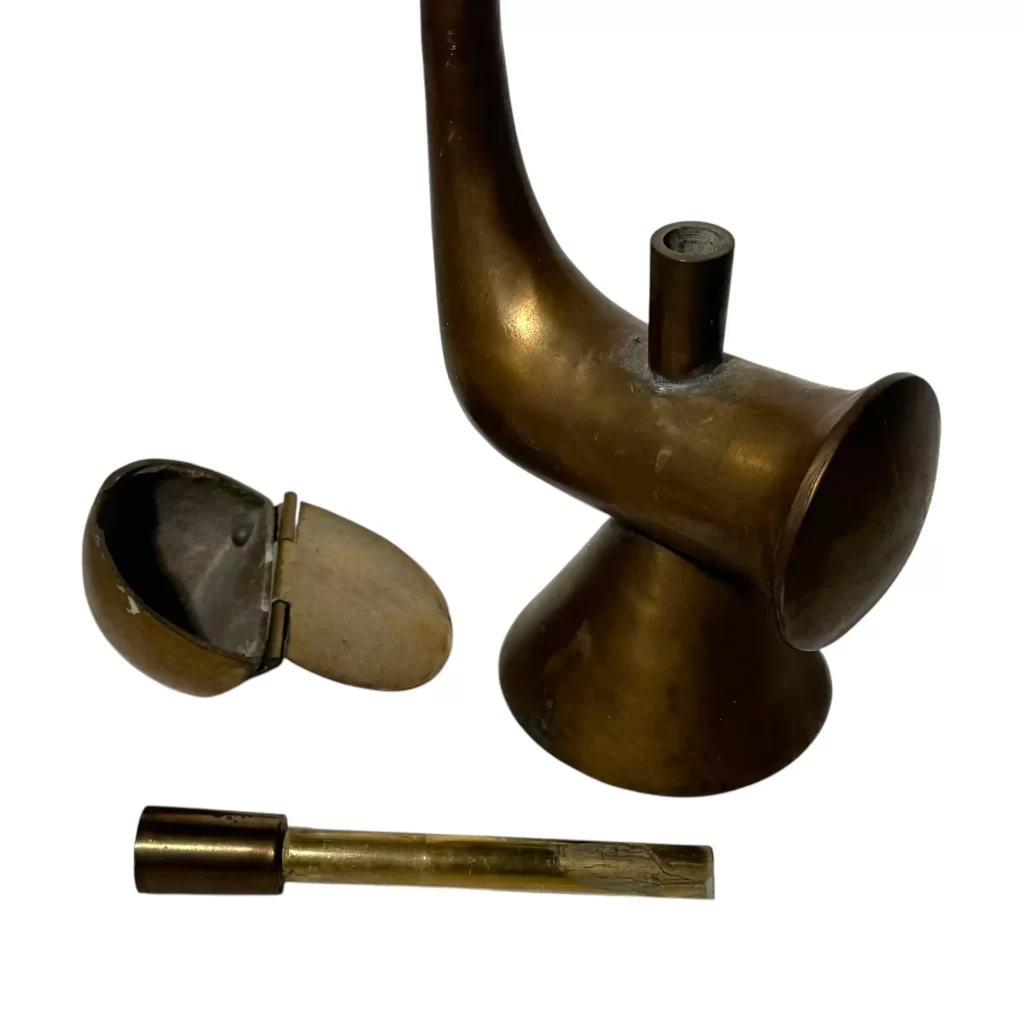
A narrow tube rises nearly twelve inches in a sweeping curve. A second, much shorter cylinder stands upright beside it. Below both is a compact, rounded body containing a hinged compartment, a large circular side section, and a flared foot that allows the entire vessel to stand independently.
It resembles a musical instrument, a scientific apparatus, and a miniature machine all at once.
For generations, objects of this form have been described throughout the Western antiques trade as Chinese opium pipes. The name is dramatic, commercially familiar, and usually incorrect.
This is more accurately identified as a Chinese water-tobacco pipe: a portable smoking system designed to burn finely cut tobacco, draw its smoke downward through water, and deliver it to the smoker through the long curved mouthpiece.
The distinction matters. It restores the object to its proper place within the history of Chinese tobacco use rather than forcing it into the more sensational history of opium.
Not an Opium Pipe
Traditional Chinese opium pipes were engineered around an entirely different process.
An opium pipe generally consisted of a long shaft made from bamboo, wood, ivory, or another material. Near one end, a separate ceramic or stoneware bowl was mounted onto a fitting known as a saddle. Prepared opium was heated over an external lamp until it vaporized. It was not simply packed into a vertical bowl and set alight like tobacco.
Singapore’s National Heritage Board draws a direct distinction between the two forms: the long Chinese opium pipe was designed to vaporize opium, while the smaller water pipe was used for tobacco combustion.
The Amsterdam Pipe Museum is even more explicit. It describes this compact metal form as one of the most characteristic Chinese tobacco pipes, while noting that it is repeatedly—and inaccurately—sold as an opium pipe in the antiques market.
That does not mean tobacco and opium existed in completely separate cultural worlds. Different substances, mixtures, and regional customs could overlap, and some museum catalogues cautiously describe comparable vessels as pipes for tobacco or opium. A nineteenth-century engraved brass example in the Science Museum Group’s collection is catalogued in precisely those broader terms.
Yet the physical design of the present object corresponds most directly to the Chinese water-tobacco pipe tradition.
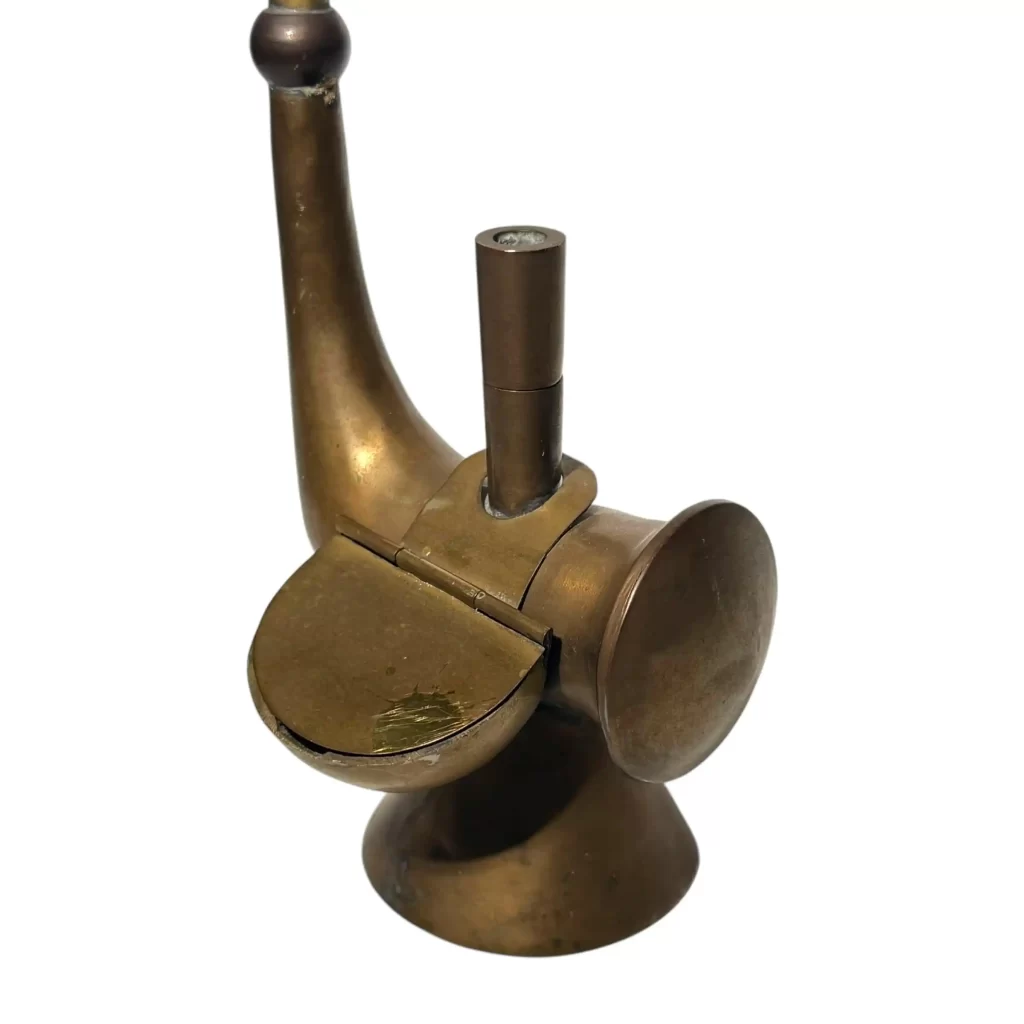
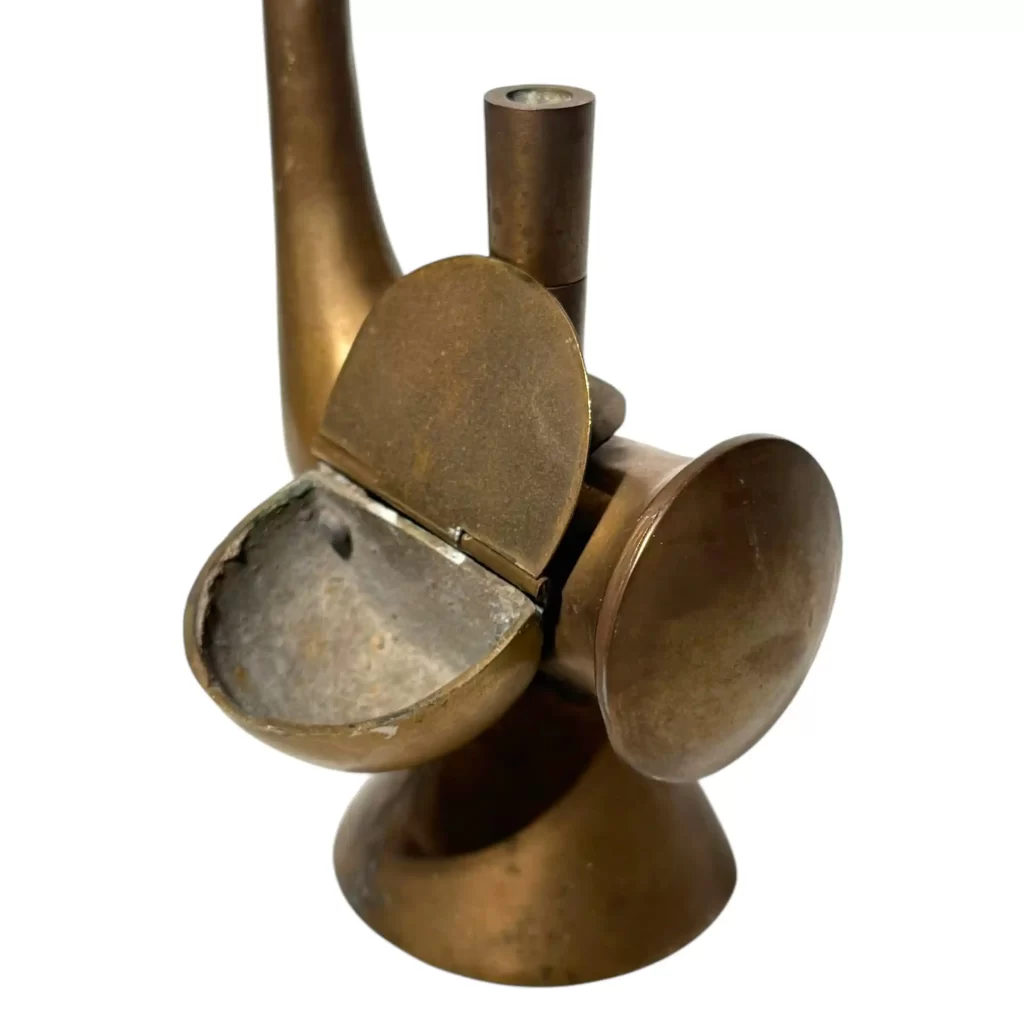
Reading the Object
The pipe becomes easier to understand once its parts are separated by function.
The short upright cylinder is the tobacco bowl. Finely cut tobacco would have been placed into its opening and ignited.
Attached beneath that bowl was a longer internal tube extending downward into the water contained inside the body. Although most of this tube is hidden from view, it was essential to the pipe’s operation.
The broad lower body served as the water reservoir.
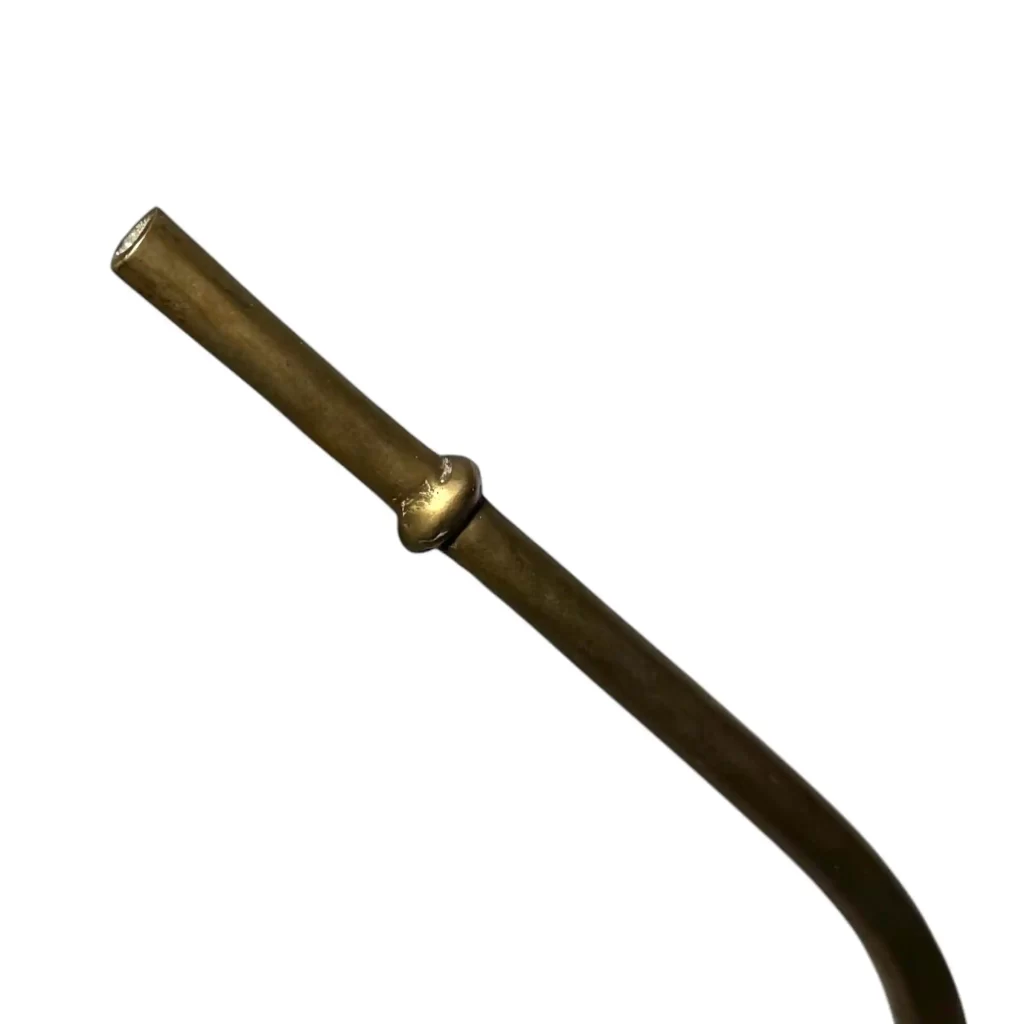
The long curved brass tube was the mouthpiece. It is the only part of the pipe that the smoker placed against the lips.
The additional chambers and covered sections formed part of a compact smoking set. Comparable Chinese examples incorporated spaces for storing tobacco, cleaning picks, brushes, stoppers, or other small accessories required for regular use. One surviving museum pipe disassembles into a bowl, water vessel and mouthpiece, storage compartment, and main body, with separate sheaths originally intended for cleaning implements.
The object was therefore more than a pipe. It was a self-contained smoking kit.
How the Smoke Traveled
The pipe operated through suction and water displacement.
First, a small quantity of water was poured into the lower reservoir. The level needed to be high enough to cover the end of the internal tube connected to the tobacco bowl.
Finely cut tobacco was then placed in the short vertical bowl and lit.
When the smoker drew from the long curved mouthpiece, air passed through the burning tobacco and carried the smoke downward through the concealed tube.
The smoke entered the water below the surface, broke into bubbles, and rose through the reservoir. It then entered the open space above the water before traveling upward through the curved mouthpiece.
The process could be heard as well as felt. Each draw would have produced a quiet bubbling or gurgling sound inside the brass body.
The water cooled the smoke and trapped some ash and particulate matter. It changed the sensation of smoking, although it did not remove the health risks of inhaling tobacco.
The Amsterdam Pipe Museum describes the same essential arrangement: a bent mouthpiece attached to a water reservoir, beside a shorter removable bowl whose tube extended beneath the water level.
Why Build It from Brass?
Simpler Chinese water pipes could be made from bamboo and other locally available materials. A metal version required more specialized fabrication.
Brass offered several practical advantages. It was durable, reusable, relatively resistant to heat, and easier to wipe clean than many porous organic materials. It could also be soldered, hammered, shaped, engraved, plated, and assembled into a surprisingly complex vessel.
The present example is visually restrained. It does not display the elaborate enamel, cloisonné, silver ornament, inscriptions, or dense engraved decoration found on some luxury pipes. Its appeal comes instead from its sculptural construction and warm, naturally aged surface.
That restraint may suggest an object intended for serious, repeated use rather than ceremonial display. It would be unwise, however, to assign it to a specific social class without documentation. A plain pipe could have belonged to a merchant, shopkeeper, household elder, traveler, or any owner who valued durability more than elaborate ornament.
What can be said with confidence is that it was not disposable. It was made to be filled, emptied, cleaned, handled, and used repeatedly.
Tobacco Becomes Chinese
Tobacco originated in the Americas and entered China through expanding global trade during the sixteenth century.
Once introduced, it did not remain an exotic foreign novelty. Chinese farmers cultivated it, merchants distributed it, consumers developed regional preferences, and craftspeople created new equipment for its preparation and use.
Historian Carol Benedict’s Golden-Silk Smoke traces tobacco’s transformation from a New World import into a deeply rooted part of Chinese economic and social life.
By the middle of the Qing Dynasty, China already possessed a differentiated market for ordinary pipe tobacco and water-pipe tobacco, including numerous recognized regional varieties.
This pipe belongs to that process of adaptation.
The tobacco plant came from abroad, but the vessel represents a distinctly Chinese response to it. Its integrated bowl, reservoir, storage chambers, standing base, and curved mouthpiece transformed an imported commodity into a localized ritual supported by Chinese craftsmanship.
Who Used Pipes Like This?
Tobacco smoking in Qing China was not restricted to a single class or gender.
Historical scholarship records Chinese men and women, wealthy and poor, posing with and carrying tobacco pipes. The materials and quality of those pipes could vary enormously, from simple utilitarian forms to expensive metal vessels made for affluent urban consumers.
A brass water pipe could therefore appear in several environments: a private household, a merchant’s reception room, a shop, an inn, or another social interior in which tea, conversation, and tobacco accompanied one another.
It should not automatically be imagined inside an opium den.
Nor should it automatically be assigned to an aristocrat. Its metal construction indicates a more substantial object than a basic bamboo pipe, but without an inscription, maker’s mark, documented owner, or firmly established chain of provenance, claims of palace or elite ownership would be speculative.
Its historical importance does not depend upon royal association.
The object is valuable because it represents a type of material culture once familiar enough to be ordinary—and now unfamiliar enough to be repeatedly misunderstood.
Reconstructing a Late Qing Smoking Scene
Imagine the pipe in use during the closing decades of the nineteenth century.
A brass oil lamp illuminates a room furnished with dark carved wood. A covered tea bowl rests on a low table beside a tobacco container, a small lighting taper, and a narrow cleaning pick.
The smoker pours fresh water into the reservoir and returns the removable bowl to its opening. A pinch of finely prepared tobacco is packed into the top.
The entire twelve-inch vessel is lifted in the hands. Because the water-filled body carries weight, the smoker supports the lower section rather than holding only the delicate stem.
The curved mouthpiece reaches the lips.
A glowing taper is placed near the tobacco. The smoker draws, and the ember brightens. Smoke moves down the internal tube and bubbles through the hidden reservoir.
The room fills not with dramatic clouds, but with a thin trace of tobacco smoke and the quiet sound of water moving inside brass.
After several draws, the ash is cleared. The bowl is repacked. Tea and conversation continue.
This reconstruction is not a documented account of the individual object’s original owner. It is a historically informed interpretation of how a pipe of this mechanical form would have functioned within the broader social world of Qing tobacco smoking.
That distinction is essential to responsible museum storytelling: interpretation should illuminate the artifact without inventing a false provenance.
A Personal Object That Required Care
Using a water pipe required more preparation than lighting a modern cigarette.
The water had to be refreshed. The bowl and submerged tube had to remain open. Residue could accumulate inside the chamber and mouthpiece. Ash had to be removed, and moisture had to be managed.
Cleaning tools were therefore part of the complete smoking set rather than optional accessories. The various covered areas and narrow compartments incorporated into Chinese water pipes made it possible to keep those tools together with the tobacco.
Repeated handling left physical evidence.
Small dents, worn edges, oxidation, darkened seams, softened surfaces, and minor irregularities can all become part of an antique pipe’s history. They should not automatically be treated as damage to be erased. In many cases, they are evidence that the object was used rather than preserved from the beginning as decoration.
The aged surface of this example gives it much of its presence. Light reflects differently across the polished high points, darker recessed areas, soldered seams, and broad side chamber, revealing how construction and use have altered the brass over time.
Dating the Pipe Responsibly
The object is provisionally dated to approximately 1880–1900, placing it within the final decades of the Qing Dynasty.
That attribution is based on its materials, construction, form, and comparison with related examples. Similar Chinese brass water pipes are held in museum collections with nineteenth-century dates, including examples catalogued broadly between 1801 and 1900.
However, the basic form remained in production for an extended period. The Amsterdam Pipe Museum notes that this style was fashionable from roughly the 1820s into the early twentieth century, which can make unsigned specimens difficult to date precisely.
Unless a maker’s inscription, securely documented provenance, or diagnostic construction feature provides firmer evidence, “circa 1880–1900” should be presented as a considered attribution—not an exact manufacturing date.
That uncertainty does not weaken the object. It places it honestly within a surviving family of Chinese smoking vessels whose form remained useful for generations.
The End of the Water-Pipe Era
By the late nineteenth and early twentieth centuries, smoking culture was beginning another transformation.
Manufactured cigarettes were lightweight, standardized, portable, and quick to consume. They required no water, bowl, cleaning tools, or reusable apparatus. Their rise gradually displaced older forms of pipe smoking, particularly in rapidly modernizing urban markets.
The brass water pipe represents an earlier relationship between the smoker and the object.
Unlike a paper cigarette discarded after a few minutes, it could remain with an individual or household for years.
Why This Pipe Matters
This object should not be important merely because it appears exotic—or because the inaccurate label “opium pipe” makes it sound controversial.
Its real history is more educational.
It shows how Chinese craftspeople engineered a compact water-filtration system from brass. Showing how a foreign plant became integrated into Chinese commerce and domestic life. It reveals that smoking involved specialized containers, tools, maintenance, sensory preferences, and social customs long before the age of mass-produced cigarettes.
It also demonstrates the responsibility of museums and collectors to question inherited labels.
For decades, the antiques market has frequently converted Chinese water-tobacco pipes into “opium pipes,” replacing an everyday social history with a more sensational narrative. Correct identification does not make the object less compelling. It makes it more meaningful.
The pipe is not simply evidence that people smoked.
It is evidence of how they smoked, what they valued in the experience, how they designed objects around the body, and how global commodities became part of local life.
Standing only twelve inches tall, it preserves an entire system of tobacco preparation, water cooling, craftsmanship, personal ritual, and late Qing material culture within a single brass form.