
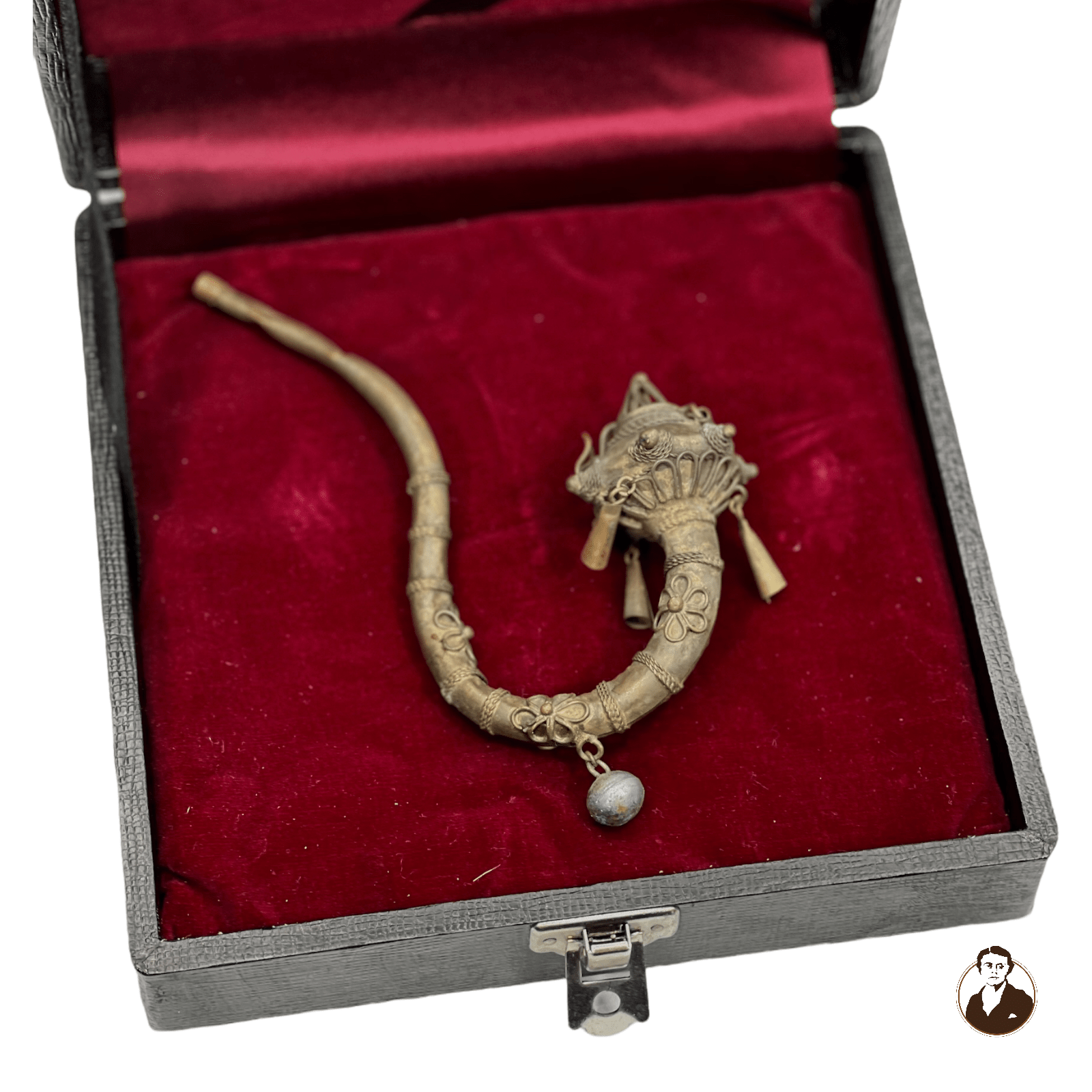
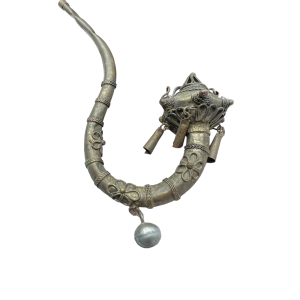
An exceptionally unusual antique ornamental smoking pipe, tentatively attributed to the Thailand–Laos region of northern mainland Southeast Asia, with a proposed mid-to-late 19th-century date. Measuring just 5 inches in length, this remarkable piece combines intricate floral metalwork, a dramatically curved stem, suspended decorative ornaments, and an elaborate six-sided smoking chamber.
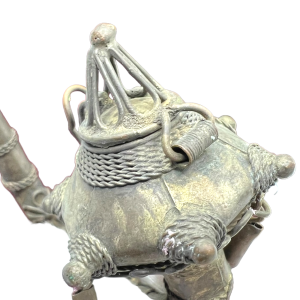
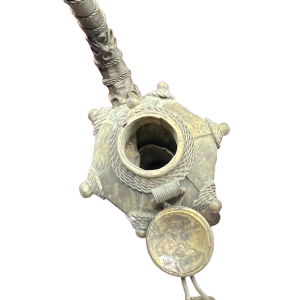
The pipe features a slender, sweeping metal stem decorated with applied floral motifs, raised bands, and finely worked ornamental details. Its most distinctive feature is the sculptural, lobed hexagonal smoking chamber, embellished with raised projections, braided-wire decoration, and an openwork crown-like structure.
Several small, cone-shaped metal pendants hang from the bowl, while a spherical pendant is suspended beneath the curve of the stem. These elements contribute to the pipe’s distinctive appearance and may have held decorative or symbolic significance, although their precise meaning remains unknown.
A small hinged metal cover provides access to the smoking chamber, demonstrating how the elaborate ornamental design incorporates functional elements of a smoking implement.
Historical Background & Provenance
This pipe was acquired from Jerusalem, Israel, where it was originally represented as a ceremonial smoking object dating to approximately 1600–1700.
Subsequent research, supported by photographs and observations shared by fellow collectors, has led to a substantially revised attribution. The strongest comparative evidence now points toward northern mainland Southeast Asia, particularly Thailand or Laos, with a proposed date in the mid-to-late 19th century.
Several closely related pipes identified during this investigation exhibit striking similarities in their curved stems, applied floral ornamentation, wirework, and elaborate bowl construction. Certain examples also incorporate elephant imagery, providing further opportunities for comparison with regional metalworking traditions.
Additional historical parallels have been identified in the collections of the Bowers Museum and Amsterdam Pipe Museum, which document finely worked silver smoking pipes associated with Thailand, Laos, and neighboring Southeast Asian cultures.
These comparisons provide a considerably stronger basis for understanding the pipe’s probable geographic origin, although its precise place of manufacture, date, and cultural association have not been conclusively established. Its original smoking purpose also remains under investigation, with tobacco considered likely and possible associations with other regional smoking traditions requiring further evidence.
The original 17th-century ceremonial attribution is therefore no longer supported by the strongest available comparisons. Its acquisition in Jerusalem remains an important part of the object’s known history but does not establish its place of manufacture or the circumstances by which it reached the region.
Materials & Craftsmanship
The pipe appears to be constructed from a silver-colored metal alloy, incorporating individually formed decorative elements, applied metalwork, braided wire, and suspended ornaments.
Its floral motifs, raised bands, and elaborate chamber demonstrate considerable attention to ornamental detail. The exact metal composition remains untested, and a definitive determination of silver content would require further examination.
Despite its compact proportions, the pipe exhibits an impressive concentration of decorative features. The combination of its curved stem, six-sided chamber, and movable pendants distinguishes it from simpler utilitarian smoking implements.
The piece remains in very good apparent antique condition, with a minor indentation near the mouthpiece and surface patination consistent with age and handling.
Object Details
Date: Probable mid-to-late 19th century (c. 1850–1900); attribution remains unverified
Acquisition Provenance: Jerusalem, Israel
Cultural Origin: Probably northern mainland Southeast Asia, particularly Thailand or Laos; precise origin undetermined
Material: Silver-colored metal alloy with applied metalwork and braided wire; composition untested
Object Type: Ornamental smoking pipe, likely intended for tobacco; original smoking use not conclusively established
Length: 5 inches
Decoration: Applied floral motifs, raised metal bands, lobed hexagonal smoking chamber, openwork detailing, hinged cover, suspended conical ornaments, and spherical pendant
Condition: Very good apparent antique condition, with minor indentation near the mouthpiece and age-related surface wear
Collector Context
An intriguing example of historical Southeast Asian smoking equipment, notable for its sculptural form, elaborate metalworking, and unusual suspended ornamentation.
Originally acquired in Jerusalem under a 17th-century attribution, the pipe has since become the subject of extensive comparative research involving museum collections and contributions from fellow collectors. These findings have significantly advanced its identification and established a promising connection to ornamental metal smoking traditions of Thailand and Laos.
Its distinctive construction, complex decorative features, and evolving attribution make this a particularly interesting piece within the History of Smoke collection, while further research may help establish its precise cultural origin, date, and intended use.


Reviews
There are no reviews yet.