
The Pipe Was Never Just for Peace
The Lakota Čhaŋnúŋpa, Pipestone & the Sacred Smoking Traditions of the Great Plains
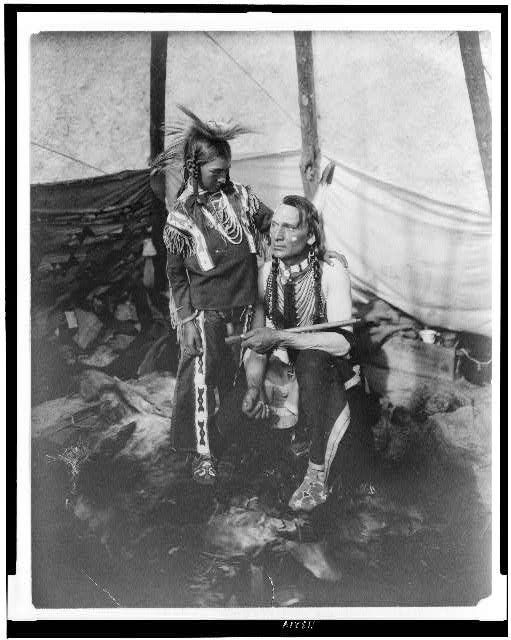
Long before “peace pipe” became the name Americans remembered, the pipe already carried meanings far beyond peace.
It could appear when people prayed.
It could be present when strangers became allies, when leaders entered council, when warriors prepared for danger, when promises were made, when guests were welcomed, or when human beings sought a connection with powers beyond themselves.
Among the Lakota, the čhaŋnúŋpa—often written canupa or chanunpa in English—is better understood as a sacred or ceremonial pipe than simply a “peace pipe.”
And its history begins somewhere unexpected.
Not with smoke.
Not with tobacco.
But underground.
In southwestern Minnesota, beneath a landscape of tallgrass prairie, lies a thin layer of deep red stone trapped within extraordinarily hard quartzite. Indigenous people have come to this place for thousands of years, removing that red stone and transforming it into pipes and other culturally important objects.
Today the landscape is protected as Pipestone National Monument.
The stone is known to geologists as catlinite.
To understand the history of the Great Plains pipe, we first have to understand why people went to such extraordinary lengths to obtain it.
The Red Stone Beneath the Prairie
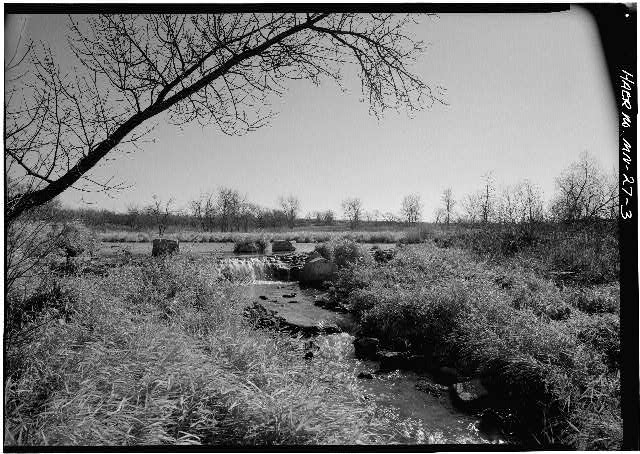
Pipestone looks soft enough that it is sometimes casually described as clay. Occasionally it is even called “fossilized clay.”
That is not quite what it is.
More than a billion years ago, ancient waterways deposited enormous amounts of sand across what is now southwestern Minnesota and the surrounding region. Between some of those sandy deposits settled extremely fine layers of mud and clay.
Over immense spans of geological time, burial, pressure, and heat transformed the sand into Sioux Quartzite and the finer sediment into a dense claystone or argillite.
At Pipestone National Monument, that particular red claystone is called catlinite. Tiny amounts of the iron-bearing mineral hematite help create its characteristic red color. Unlike many other red pipestones, Minnesota catlinite contains very little or no quartz.
The contrast between the two neighboring stones is remarkable.
Sioux Quartzite is around 7.5 on the Mohs hardness scale. Catlinite is approximately 2.5—close to the hardness of a fingernail.
Once a good piece of pipestone is in a carver’s hands, it can be shaped with relative ease.
Getting to it is another matter entirely.
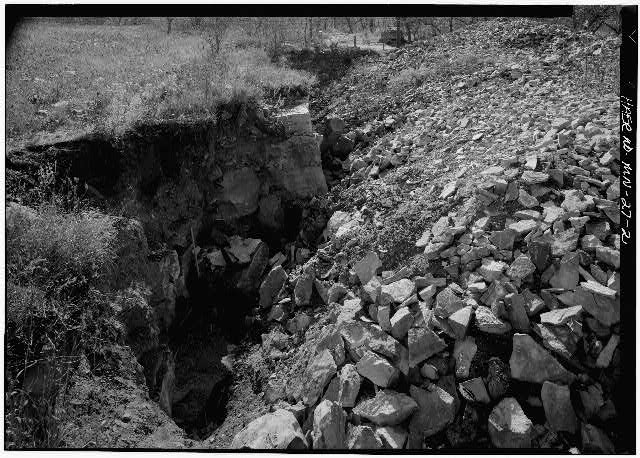
The soft red layer can sit beneath several feet of quartzite. Modern quarriers still work downward with hand tools, breaking and removing the harder stone before they ever reach usable pipestone. The National Park Service warns prospective quarriers that reaching the pipestone layer can take days, weeks, months, or even years. Power tools are not permitted in the quarries.
So every traditional pipestone bowl begins with an overlooked part of the story:
labor.
Before the carving comes the quarry.
Before the smoke comes the stone.
Pipestone Is Ancient. That Does Not Mean Every Part of Its History Is Lakota.
This distinction is one of the most important to understand if we want to tell the story accurately.
Archaeological evidence indicates that people have been using the Pipestone quarry landscape for roughly 3,000 years. Pipestone also traveled far beyond Minnesota through Indigenous exchange networks.
But it would be a mistake to take every ancient pipestone artifact and simply label it “Lakota.”
The Indigenous history of North America is much older and more culturally complicated than the tribal boundaries familiar from nineteenth-century maps.
Many peoples have histories connected to the quarry. Today, Pipestone National Monument formally consults with 23 affiliated Tribal Nations, including Dakota, Lakota, Nakota, Iowa, Otoe-Missouria, Ponca, Omaha, and Mandan, Hidatsa and Arikara communities.
By around 1700, National Park Service research identifies Dakota people as the dominant presence at the quarries. Early European reports from around this period begin describing communities associated with the red-stone quarry.
From there, the historic connection between the quarry and the peoples of the Oceti Sakowin—the Seven Council Fires commonly divided in English into Dakota, Nakota, and Lakota groupings—becomes increasingly visible in documentary evidence.
But ancient pipestone history and historic Lakota pipe tradition should not be collapsed into a single uninterrupted claim.
The stone is ancient.
The traditions are ancient.
The exact histories of the peoples who used the stone changed across time.
That complexity does not weaken the story.
It makes it more interesting.
What Was a Native American “Peace Pipe”?
If there is one phrase that has distorted the history of Indigenous smoking more than any other, it may be peace pipe.
The phrase is not completely meaningless.
Pipes really were used during diplomacy. Europeans encountered ceremonial smoking during councils, treaty negotiations, alliance-making, trade, and other political meetings.
From the outsider’s point of view, the association was obvious:
A pipe appeared.
People smoked.
An agreement followed.
The “peace pipe” was born in the European imagination.
But Plains peoples used pipes for far more than making peace. National Park Service historical interpretation specifically notes their use in activities that included peace-making, warfare, trade, ritual, and other ceremonies.
That means the problem is not that pipes were never associated with peace.
The problem is taking one use and turning it into the name of the entire tradition.
A church bell can announce a wedding.
That does not make “wedding bell” the complete definition of every church bell.
The same principle applies here.
Different Indigenous nations possessed their own pipe traditions, terminology, protocols, stories, designs, and ceremonial meanings. There was never one universal Native American pipe ceremony shared identically across the continent.
For Lakota history in particular, čhaŋnúŋpa, sacred pipe, prayer pipe, or ceremonial pipe gives us a much better starting point.
The Lakota Čhaŋnúŋpa
A museum label might describe a historic pipe in a few words:
Catlinite. Wood. Lakota. Nineteenth century.
Technically, all of that may be correct.
It also tells us almost nothing about why the object mattered.
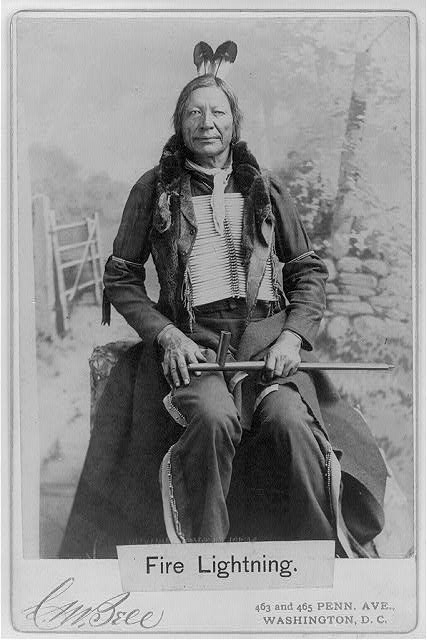
Within Lakota sacred tradition, the čhaŋnúŋpa is connected to the story of White Buffalo Calf Woman, who brought the sacred pipe and teachings to the people.
One of the best-known twentieth-century accounts was given by the Oglala Lakota holy man Black Elk to Joseph Epes Brown in the 1940s. The National Park Service also preserves and discusses other Lakota tellings of the pipe’s sacred origin.
These are living sacred traditions, not simply archaeological explanations for an old object. Different Lakota tellings can contain different details, and they should not be forced into one supposedly definitive version by outsiders.
What matters for understanding the pipe historically is the worldview behind them.
A čhaŋnúŋpa was not simply a clever way to burn dried leaves.
The bowl, stem, plants, fire, breath, smoke, prayer, and people participating could exist within a network of relationships extending far beyond the individual smoker.
The pipe could connect earth and living things.
It could accompany words intended to carry obligation.
It could turn an ordinary act into a sacred one.
This is the point where modern language sometimes fails us.
We tend to categorize objects by function.
A knife cuts.
A cup holds liquid.
A pipe produces smoke.
But ceremonial objects do not fit neatly into that system.
The better question is not:
What did this object do?
It is:
What happened when people brought it into a particular moment?
What Did the Lakota Actually Smoke?
This may be the most irresistible question in the entire subject.
Open an old ceremonial pipe.
What would have been inside?
The most accurate answer is frustratingly simple:
It depended.
There was no single pan-Indigenous smoking mixture.
There was not one secret “Native American tobacco recipe” used by every nation.
Different communities smoked different plants, cultivated different tobacco species, traded with neighboring peoples, and prepared mixtures according to local knowledge and ceremonial context.
For Lakota smoking history, however, one plant deserves special attention.
Čhaŋšáša: The “Red Willow” That Isn’t a Willow
The Lakota word čhaŋšáša, often written cansasa, is commonly associated with a plant called red willow.
Botanically, the name is misleading.
The plant usually identified this way is red-osier dogwood, Cornus sericea, not a true willow in the genus Salix. South Dakota State University’s Native Plant Research program identifies Cornus sericea with the Lakota name čhaŋšáša.
The inner bark could be prepared for smoking and could occupy the cultural role that English speakers tend to translate simply as “tobacco,” even though the plant contains no Nicotiana tobacco at all. Indigenous-led tobacco research has emphasized precisely this distinction between sacred or traditional tobacco and modern commercial tobacco.
And here we have something better than a nineteenth-century writer’s description.
We have the material itself.
The Smithsonian’s National Museum of the American Indian preserves a Hunkpapa Lakota smoking mixture from Standing Rock Reservation.
Its exact collection history is uncertain, but it was formerly owned by Western painter De Cost Smith and may have been collected between 1884 and 1900.
The museum identifies the contents as:
shredded willow bark.
No tobacco leaf is listed in the surviving mixture.
It is an extraordinary little object.
Beside the decorated stone pipes that draw attention in museum displays sits a bundle of shredded bark that answers one of the questions people have been asking for more than a century.
Sometimes, what went into the pipe was not conventional tobacco at all.
Indigenous Tobacco Before Commercial Tobacco
None of this means tobacco itself was unimportant.
Quite the opposite.
Long before European colonization transformed tobacco into a global commodity, Indigenous peoples of the Americas had developed their own sophisticated relationships with Nicotiana plants.
Tobacco could be cultivated carefully, selected, harvested, processed, traded, offered, burned, and smoked within social and ceremonial systems that varied dramatically from one nation to another.
One species important in North American Indigenous tobacco traditions is Nicotiana rustica.
It is not the same plant that dominates today’s commercial cigarette and pipe-tobacco industry, where Nicotiana tabacum became overwhelmingly common.
Traditional tobacco research among Native communities continues to emphasize the difference between Indigenous ceremonial tobacco practices and commercial tobacco consumption.
That distinction matters historically because the arrival of packaged commercial tobacco did not create Native smoking traditions.
It entered worlds where smoking already had histories, meanings, plants, rules, and trade networks of its own.
Tobacco Traveled Across the Plains
Imagine the Great Plains not as isolated tribes separated by empty space, but as a vast web of movement.
People moved.
Horses moved.
Buffalo products moved.
Corn, beans, tools, cloth, weapons, stone, medicines, stories, and tobacco moved.
The great agricultural communities along the Missouri River were especially important within these networks.
Mandan, Hidatsa, and Arikara communities cultivated crops in permanent or semi-permanent settlements while neighboring Plains peoples traveled through enormous buffalo-hunting territories.
Tobacco could move between these different economies.
This is where smoking history becomes trade history.
A Lakota smoker did not necessarily grow every plant that entered his pipe.
The material could arrive through exchange with another nation.
And once we understand that, the bowl of a pipe begins to look much larger.
Inside that tiny chamber could meet a stone quarried hundreds of miles away, a stem shaped elsewhere, tobacco produced by agricultural people along the Missouri, and a ceremony belonging to the community in which those materials finally came together.
The history of smoke is often a history of connection.
What About Kinnikinnick?
Another word almost guaranteed to appear in any search for traditional Native smoking mixtures is kinnikinnick.
Today it is frequently marketed as though it were one historical recipe:
a little bark, a few herbs, perhaps some bearberry, perhaps tobacco—mix them together and you have “the Native blend.”
History is not that tidy.
“Kinnikinnick” has been applied to smoking mixtures that could contain different regional plants and could vary between communities and periods. Red-osier dogwood, bearberry, tobacco, and other botanicals all appear in the broader literature on Indigenous smoking mixtures. Indigenous tobacco scholarship specifically cautions that different peoples maintained their own relationships with different plants.
So an antique pipe should never be paired automatically with some modern “traditional kinnikinnick” recipe and presented as historically reconstructed.
The first questions should always be:
Which people?
place?
time?
and ceremony?
That is the difference between historical interpretation and costume.
How Was a Ceremonial Pipe Actually Smoked?
This is another question that becomes less simple the closer we look.
There was no universal procedure called “how Native Americans smoked the peace pipe.”
Different nations—and different ceremonies within those nations—could handle pipes differently.
The Smithsonian’s National Museum of the American Indian describes one ceremonial pattern in which the bowl and stem are joined, the completed pipe is cleansed in sage smoke, tobacco is placed into the bowl, the pipe is lit, and participants smoke while praying.
That is useful evidence.
It is not an instruction manual for every historic pipe ceremony.
In different contexts, particular individuals might be responsible for carrying, filling, lighting, presenting, or caring for a pipe. Directional movements or offerings could matter. Words spoken over the pipe could matter. The order of participants could matter.
Even the physical act of drawing smoke should not automatically be understood through the habits of modern cigarette smoking.
In ceremonial contexts, smoking could be only one part of a sequence of actions carrying meaning as a whole.
That is why reproducing a sacred ceremony from a museum description misses the point.
Some knowledge belongs to living communities and ceremonial practitioners rather than to a public historical checklist.
For the historian, the safer and more interesting question is:
Why was the pipe being raised at this particular moment?
The Pipe Could Appear in Peace. It Could Also Appear Under Gunfire.
Few stories destroy the stereotype of the harmless “peace pipe” faster than one involving Sitting Bull.
National Park Service historical interpretation recounts a remarkable episode in which Sitting Bull and several other men sat smoking while under enemy fire.
Bullets struck the ground around them.
The others smoked quickly.
Sitting Bull remained calm.
After finishing, he cleaned the bowl and walked away while shots continued around him.
White Bull later remembered the act as an extraordinary demonstration of courage.
Whatever else the story tells us, it destroys the idea that the presence of a pipe automatically signaled peace.
Here the pipe appears in the middle of battle.
Its use communicated composure, resolve, courage, perhaps prayer—and something understood by the people watching that would be badly translated by simply calling the object a “peace pipe.”
The pipe did not necessarily announce:
There will be no violence.
Sometimes it declared something closer to:
What we are doing now matters.
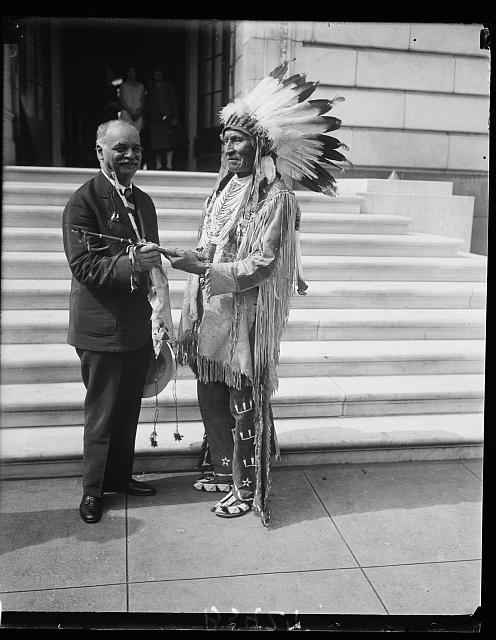
A Complete Pipe Was Far More Than Its Bowl
Visit enough antique shops, auction houses, or museum collections and you begin seeing the same thing:
red stone pipe bowls without their stems.
The bowl survives because stone survives.
The rest of the pipe may not.
This can distort our mental image of what these objects once looked like.
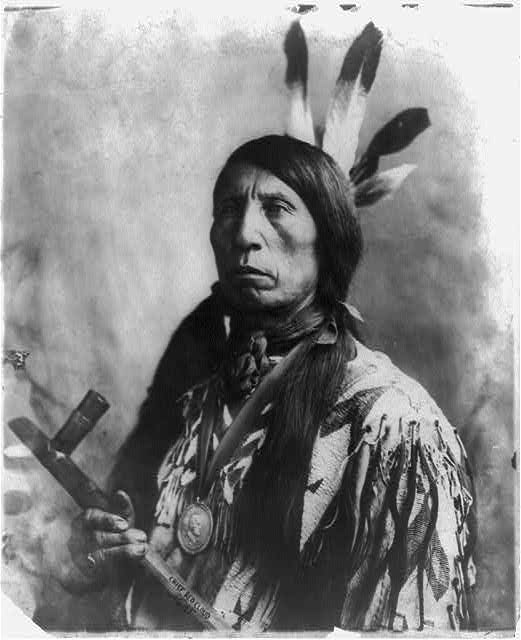
Historic Plains pipes could be long, dramatic, elaborately decorated objects incorporating several different materials.
One Lakota example at the National Museum of the American Indian, associated with Standing Rock and probably dating around 1880, measures 65 centimeters—roughly 25½ inches—long.
Its materials include catlinite, wood, porcupine quills, dyes, horsehair, mallard duck skin, sinew, and cotton string.
Another Hunkpapa Lakota example associated with Standing Rock and possibly collected between 1884 and 1900 has a carved wooden stem and catlinite bowl.
Think about what happens when we describe such an object merely as “a tobacco pipe.”
Stone from the earth.
Wood from a living plant.
Animal materials.
Human carving.
Color.
Wrapping.
Decoration.
Smoke.
Prayer.
Memory.
Potentially hundreds of miles of movement between where those materials originated and where they came together.
Calling it smoking equipment is like calling a ceremonial chalice a cup.
Technically correct.
Historically useless.
![Massasoit--On his way to meet the Pilgrims and sign the Peace Treaty, 1621 / Waud & Jenkins, Cambridge ; [sic] by Alexander Gilmore, Boston.](https://historyofsmoke.com/wp-content/uploads/2026/09/service-pnp-cph-3c20000-3c20000-3c20500-3c20508r.jpg)
Why Red Pipestone?
Catlinite was never the only material Indigenous peoples used for pipes.
Across North America, pipes were made from many kinds of stone, clay, wood, and other materials. Even the category “red pipestone” includes geological sources other than the famous Minnesota quarry.
But catlinite has physical characteristics unusually well suited to carving.
It is fine-grained, takes detail, and can be polished
And its deep red color gives it an unmistakable visual presence.
Then there is the quarry itself.
For many Indigenous peoples connected to Pipestone, the place is not merely a convenient geological deposit.
It is a sacred landscape.
Different nations maintain different traditions explaining the stone and the quarry, which is another reason not to flatten them into a single “Native American legend.” The National Park Service itself warns that multiple stories exist and that no one account should be treated as speaking for every affiliated people.
The landscape has meaning because generations of human beings have returned to it.
A pipestone pipe therefore carries something that a factory-made pipe never could.
Its material has a place.
George Catlin Did Not Discover Pipestone
The name catlinite creates one of the stranger ironies in this history.
It honors George Catlin, the nineteenth-century American artist famous for painting Indigenous people across the West.
During his travels in the early 1830s, Catlin repeatedly saw Native men using striking red pipes and became fascinated by reports of the quarry from which the material came.
In 1836, despite Indigenous objections to his visit, Catlin traveled to the quarry and removed a stone sample. After he sent it east for analysis, the material entered Western scientific vocabulary under a name derived from his own.
But Catlin was not the first European to know about the quarry.
He was not even the first white visitor documented there.
French records referring to the red-stone quarry reach back to around 1700, and American Fur Company trader Philander Prescott described visiting it in 1832, four years before Catlin.
Most importantly, Indigenous people had known the quarry for centuries before any European wrote its location on paper.
Catlin helped make the place famous to white America.
He did not discover it.
Yet the Western geological name remained attached to him.
There is perhaps no better example of how museum language can preserve the history of the collector more visibly than the history of the people who already understood the object.
The 1858 Treaty: A Sacred Quarry Becomes a Political Fight
By the middle of the nineteenth century, control of land across Minnesota and the Great Plains was changing violently and rapidly.
Treaties transferred enormous territories to the United States.
Indigenous nations were pressured onto reservations.
Settlers moved onto formerly Native-controlled land.
Railroads followed.
The pipestone quarry became caught directly in that struggle.
The Iháŋktȟuŋwaŋ, commonly called the Yankton, maintained a particularly important relationship with the quarry.
During negotiations with the United States in 1858, Iháŋktȟuŋwaŋ leader Struck-By-The-Ree refused to accept the treaty without protection for access to Pipestone.
Article VIII ultimately guaranteed the Yankton the “free and unrestricted use” of the Red Pipestone Quarry and required the United States to preserve access for obtaining stone for pipes. A one-square-mile reservation was established around the quarry.
On paper, the protection was remarkable.
On the ground, the struggle continued.
Settlers entered the reserve.
Commercial extraction took place.
A homestead claim was made within the protected area.
A railroad crossed the land.
Government promises had not made the quarry untouchable.
And then the contradiction became even more severe.
A Boarding School Beside a Sacred Quarry
In the late nineteenth century, the United States pursued policies designed explicitly to assimilate Indigenous people into Euro-American society.
Children were taken or sent to boarding schools where Native languages, names, clothing, religions, and community ties could be deliberately suppressed.
One of those institutions was established at Pipestone.
Congress authorized the Pipestone Indian School on part of the quarry reservation despite Iháŋktȟuŋwaŋ objections. The school opened in the 1890s and remained in operation well into the twentieth century.
Consider the geography of that for a moment.
Beside a landscape where Indigenous people had traveled for generations to obtain stone for sacred pipes stood an institution created to reshape Indigenous children according to the values of the United States.
At roughly the same time, Euro-American collectors were acquiring Native pipes.
Museums were filling.
Artists were painting Indigenous ceremonies.
Tourists were becoming fascinated by the romance of the “Old West.”
The pipe was becoming collectible while the culture surrounding it was under pressure.
America romanticized the “peace pipe” while attacking many of the traditions that gave the pipe its meaning.
That contradiction belongs at the center of the story.
The Late Nineteenth-Century Pipe Did Not Belong to a Vanished World
Many of the Plains pipes that survive today entered collections during the final decades of the nineteenth century.
That timing can encourage another dangerous illusion.
We look at an object labeled “Lakota, circa 1880” and unconsciously imagine it as the final artifact of a culture disappearing into history.
But the people did not disappear.
The traditions did not simply stop.
They adapted, survived, changed, went underground when necessary, re-emerged, and continued through families and communities.
The Smithsonian objects from Standing Rock are powerful precisely because they come from this period of enormous disruption.
There is the carved catlinite bowl.
The wooden stem, quillwork, and horsehair.
There is the little collection of shredded smoking bark.
These objects are not props from a vanished frontier.
They are surviving pieces of people’s lives.
And their descendants are still here.
Pipestone Is Still Quarried Today
The quarry is not closed.
The tradition is not merely commemorated.
Pipestone is still physically removed from the earth and carved.
Current National Park Service rules reserve quarry permits for members of federally recognized tribes. Enrollment must be documented, and people assisting directly with quarrying must also meet the enrollment requirements. The Monument manages 56 quarry pits through its permit system.
The stone must still be reached by hand.
The quartzite still has to be broken.
The quarry still demands effort.
And pipes made from the stone continue to be used in prayer and ceremony.
That matters because it changes the tense in which this story should be told.
Not:
The Lakota had sacred pipes.
But:
The Lakota have sacred-pipe traditions whose histories extend far into the past.
Not:
Pipestone was sacred.
But:
Pipestone remains sacred to many Indigenous people.
A historical object can be old without the culture it belongs to being dead.
Why “Peace Pipe” Is Not Enough
The phrase will probably never disappear.
It is too deeply embedded in American movies, books, advertisements, antiques catalogs, cartoons, Western art, and popular memory.
And used carefully, it can still describe a historical situation in which a pipe participated in peace-making.
But it should never be the end of the explanation.
Because once we look closer, the object expands.
A red stone bowl might begin deep beneath the prairie in Minnesota.
The stone might be removed by hand after days or months of work.
It might travel hundreds of miles.
A wooden stem might be carved separately.
Quills, hair, feathers, hide, cloth, dyes, or other materials might transform it into an object unlike any ordinary smoking implement.
Čhaŋšáša might be gathered and prepared.
Tobacco might arrive through trade.
The pipe might be assembled for prayer.
Its smoke might accompany an agreement.
Or healing, preparation for war, or an obligation whose meaning was understood only by the people participating.
Or an obligation whose meaning was understood only by the people participating.
This is why the phrase “peace pipe” feels so small once you know the history.
The pipe was never simply an emblem of peace.
It belonged to a much larger world of relationships.
More Than Smoke
Smoke is a strange subject for a museum.
It does not survive.
A flame touches a plant.
Smoke appears.
It curls into the air.
Then it is gone.
What survives are the things that surrounded it.
A stone bowl.
A worn stem.
A bag of shredded bark.
Tobacco seeds buried in an archaeological site.
Marks left in an old quarry.
A nineteenth-century painting.
A treaty written by a government trying to take land while promising access to one sacred place.
A museum catalog card.
An oral history.
A story carried by a family.
A pipe still raised in prayer today.
Put those fragments together and a very different history appears.
The Native American “peace pipe” of popular imagination becomes the Lakota čhaŋnúŋpa, the Dakota pipe, the Ponca pipe, the Omaha pipe, the Mandan pipe, the Hidatsa pipe, the Arikara pipe—and many other distinct traditions that should never have been compressed into one stereotype in the first place.
The red stone becomes more than a material.
The tobacco becomes more than tobacco.
Smoking becomes more than consumption.
And the pipe becomes more than an object.
That may be the most important lesson hidden inside the history of smoke.
The smoke disappeared.
The relationships it represented were meant to remain.
Sources & Further Reading
This article was built from museum records, National Park Service research, Indigenous-centered tobacco scholarship, historical records, and surviving nineteenth-century material culture. Particularly valuable resources include the National Park Service’s research and interpretation at Pipestone National Monument, the Smithsonian National Museum of the American Indian collections, South Dakota State University’s Indigenous plant records, and peer-reviewed work distinguishing traditional Indigenous tobacco from commercial tobacco.
For further study, see the National Park Service materials on the geology and history of Pipestone, the 1858 Yankton treaty and Pipestone Indian Reservation, George Catlin’s visit, White Buffalo Calf Woman and the gift of the pipe, modern quarrying regulations, and the Smithsonian’s catalog of historic Lakota pipes and smoking materials.