
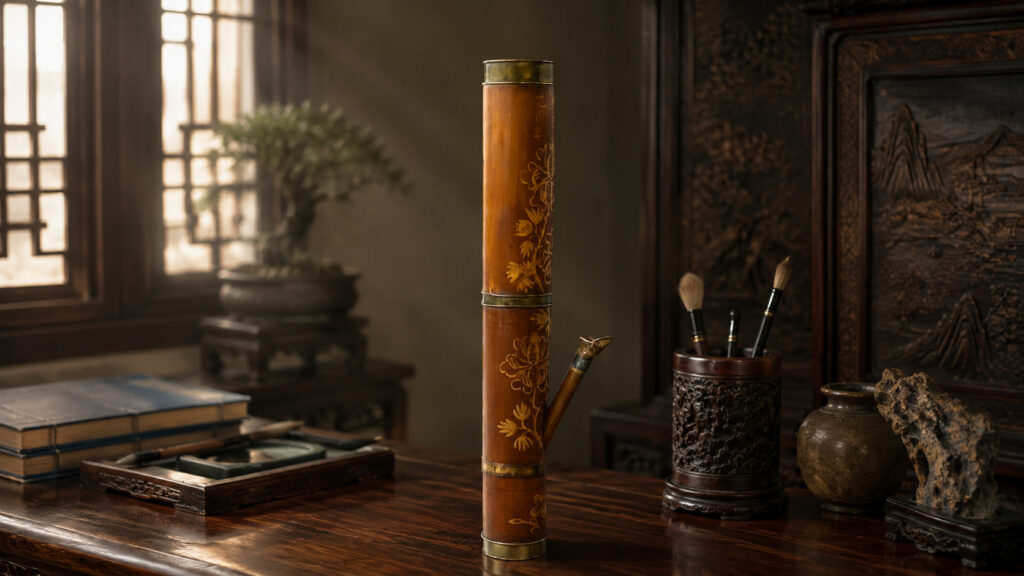
At first glance, this Chinese water pipe appears almost austere: a tall cylinder of warm amber-colored bamboo, strengthened by narrow metal bands and fitted with a small angled bowl and downstem. Look more closely, however, and its quiet complexity begins to emerge.
Delicate floral decoration travels across the bamboo surface. Separate sections have been carefully fitted together. Thin metal collars protect vulnerable edges and joints. A visible split running along the body records the effects of age, use, travel, and the natural movement of bamboo over time.
According to family provenance, the pipe was brought home from China by an American World War II veteran. That history transforms an already evocative smoking implement into something more personal: a surviving link between Chinese domestic craft, wartime travel, and one serviceman’s return home.
Now preserved by the History of Smoke Museum, the pipe offers a compelling opportunity to explore Chinese smoking culture, bamboo craftsmanship, water-pipe design, and the complicated historical setting in which the object reportedly left China.
Object Identification
Chinese Bamboo Water Pipe
China
Probably early-to-mid 20th century, traditionally dated circa 1940s
Bamboo with thin metal bands and floral decoration
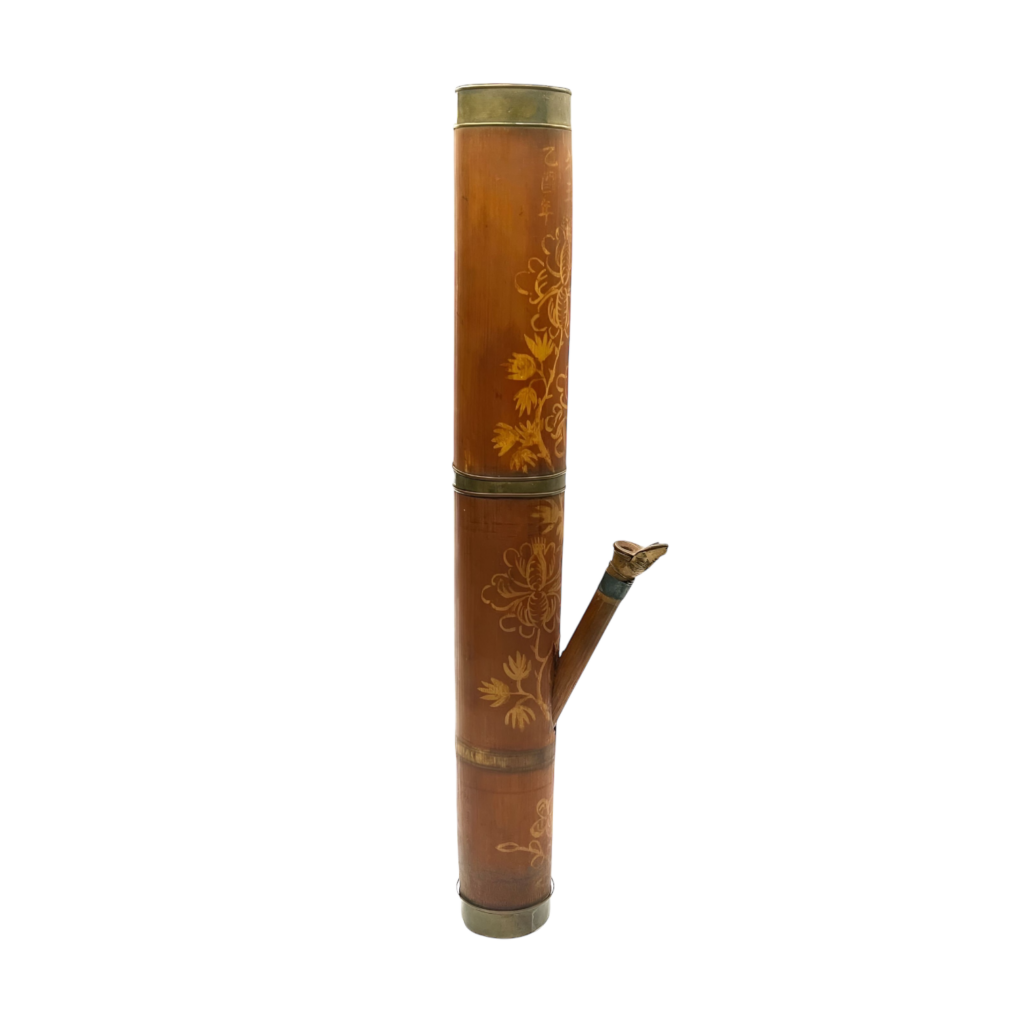
The pipe consists of a long, upright bamboo body formed from multiple fitted cylindrical sections. Narrow metal collars reinforce the top, base, and major joints. A short bamboo downstem projects diagonally from the lower portion of the body and terminates in a shaped bowl with additional metal reinforcement.
Its construction appears deliberately simple, but it is not crude. The maker understood how to use the natural hollowness of bamboo, how to join its sections, and where thin metal fittings were needed to prevent splitting or wear.
The pipe’s exact workshop and region of manufacture are unknown. Its current dating to the 1940s is based primarily on family provenance connecting it to a World War II veteran rather than on an inscription, maker’s mark, or laboratory test.
The most responsible description is therefore:
Chinese bamboo water pipe, probably early-to-mid 20th century, traditionally dated circa 1940s.
Family Provenance and the World War II Connection
According to the veteran’s son, the pipe was brought home from China by his father following World War II service.
Oral family history is a meaningful form of provenance. It records information passed directly through the family of the person associated with an object. However, it differs from fully documented provenance supported by service records, photographs, letters, receipts, or wartime inventories.
The most accurate museum wording is:
According to family provenance, the pipe was brought home from China by an American World War II veteran.
This phrasing preserves the family’s account without claiming documentary confirmation that has not yet been located.
The story is historically plausible. The United States established a military theater in China soon after entering World War II, with American personnel serving across the wider China-Burma-India Theater. U.S. operations included advising and supporting Chinese forces, aviation, transportation, communications, medical work, logistics, and the movement of supplies into China over the Himalayas.
The best-known American group associated with wartime China was the American Volunteer Group, popularly called the Flying Tigers. After the United States entered the war, Claire Chennault went on to command the Fourteenth Air Force in China.
American servicemen also worked on the ground in transportation and support roles. The U.S. Army Transportation Museum preserves wartime imagery of American vehicles and personnel operating in China, while official Army histories document the extensive logistical mission connecting China, Burma, and India.
Without the veteran’s identity or military record, it is not yet possible to determine whether he served directly in mainland China, acquired the pipe elsewhere in the theater, or obtained it shortly after the war.
Even so, the family account places the object within a credible historical framework.
What Is a Chinese Bamboo Water Pipe?
A water pipe directs smoke through a chamber containing water before it reaches the smoker. Although water-pipe forms vary considerably across Asia, they usually contain four basic elements:
- a bowl that holds tobacco;
- a tube carrying smoke downward;
- a reservoir containing water;
- an opening or mouthpiece from which the smoke is drawn.
In this example, the upright bamboo cylinder likely served as the principal body and water chamber. The angled side assembly appears to combine the bowl and downstem, allowing smoke to travel into the vessel.
The precise internal arrangement cannot be confirmed from exterior photographs alone. A careful inspection of the interior would be needed to determine the original water level, airflow path, and whether any removable tube or internal fitting is missing.
The object should not automatically be described as an opium pipe. Chinese opium pipes generally developed as a distinct class of smoking equipment with specialized bowls and long stems. The British Museum’s Chinese collections contain numerous 18th- and 19th-century opium pipes that differ substantially in form from this vertical water pipe.
Its construction is more consistent with a pipe intended for tobacco or another combustible smoking mixture, although residue analysis would be needed to identify what was actually burned in it.
Tobacco and Pipe Smoking in China
Tobacco originated in the Americas and spread internationally through European maritime trade. By the late Ming and early Qing periods, tobacco had become established in China and was smoked using a wide variety of regional pipe forms.
Chinese smoking equipment was never limited to a single standardized design. Museum collections preserve pipes made from porcelain, metal, ceramic, wood, and combinations of materials. One Qing dynasty example in the British Museum was made in the form of a lotus pod, demonstrating how functional smoking equipment could also become an object of artistic invention.
Other surviving objects range from elaborate silver opium pipes to ordinary regional tobacco pipes and water pipes. These differences reflect the diversity of Chinese geography, material traditions, social settings, and smoking practices.
A bamboo water pipe occupies a different cultural position from an expensive silver or porcelain pipe. Its materials suggest practicality and local availability, yet its floral decoration and fitted metalwork show that utility did not exclude beauty.
Why Bamboo Was an Ideal Material
Bamboo was particularly well suited to pipe construction.
Unlike solid wood, bamboo naturally grows as a hollow tube divided by nodes. An artisan could use this existing structure to create a lightweight, durable vessel with relatively little material removal.
Bamboo also offered several practical advantages:
- it was widely available in many parts of China;
- it was light enough to carry;
- its cylindrical form required minimal reshaping;
- its walls could be cut, polished, decorated, and fitted;
- it could be joined to other bamboo sections;
- and damaged edges could be reinforced with metal collars.
The material is strong along its grain but can split lengthwise as it dries, ages, or experiences changes in humidity. The visible split on this pipe is therefore consistent with the natural behavior of aged bamboo.
That split should not automatically be interpreted as wartime damage or evidence of a particular journey. It may reflect ordinary material movement, long-term use, impact, environmental changes, or a combination of these factors.
Even so, it has become part of the pipe’s history. The damage records the vulnerability of natural materials and the object’s survival across approximately eight decades.
How the Pipe Was Constructed
The pipe was not carved from one continuous piece of bamboo. It appears to have been assembled from several selected sections joined vertically and reinforced at the seams.
The main body
The tall central body forms the largest part of the pipe. Its cylindrical shape preserves the natural growth pattern of bamboo rather than disguising it.
Different sections appear to have been fitted together to achieve the necessary height and internal capacity. The joints are secured or protected by narrow metal bands.
The bowl and downstem
A smaller bamboo tube projects diagonally from the main body. This likely carried smoke from the bowl into the water chamber.
The assembly terminates in a shaped bowl or bowl holder. Bamboo appears to remain the principal structural material, while thin metal sheets or bands wrap selected portions of the bowl and joint.
A precise description would be:
Bamboo bowl and downstem with thin metal banding and reinforced fittings.
The metal probably served more than one purpose. It may have strengthened cut bamboo edges, secured joined sections, protected areas exposed to heat, and provided a neater finished appearance.
Metal collars
The upper rim, central joints, and base are enclosed by narrow metal collars.
These bands helped stabilize the pipe at points where bamboo was most vulnerable to splitting. The bottom collar may also have protected the vessel from repeated contact with floors or tables.
The metal has developed a muted aged surface, harmonizing with the warm brown bamboo rather than appearing as bright modern hardware.
Floral Decoration and Surface Design
Although modest in material, the pipe was decorated with care.
Golden or pale floral motifs extend vertically along the bamboo body. Large blossoms are accompanied by leaves, curling stems, and smaller buds. Their arrangement follows the natural height of the pipe, emphasizing its slender vertical form.
The decoration may have been engraved, incised, painted, inlaid, or produced through a combination of techniques. Close examination under magnification would help determine whether the lighter areas are cut into the surface, filled with pigment, or created by selectively removing a darker outer layer.
The flowers appear stylized rather than scientifically botanical. This is common in decorative arts, where blossoms are often adapted for rhythm, symmetry, and visual balance rather than literal identification.
Floral imagery in Chinese art can carry associations with beauty, seasonal change, endurance, refinement, and renewal. The precise symbolism here cannot be established without identifying the species and examining the full design, but the ornament clearly elevates the pipe beyond a completely undecorated utilitarian object.
Its maker combined inexpensive natural material with decorative attention, producing an object that was both useful and visually appealing.
Was It a Common Household Object?
The pipe’s materials suggest that it was not intended as a rare court luxury. Bamboo was accessible, practical, and closely connected to regional craft traditions.
It may have been used in:
- a domestic interior;
- a rural or provincial household;
- a workshop or business;
- a teahouse or informal social setting;
- or as a portable personal pipe.
Its exact social context remains unknown. The floral decoration indicates pride in appearance, but it does not necessarily imply ownership by a wealthy or socially prominent individual.
This is one of the reasons the pipe is historically valuable. Museums often preserve luxurious objects because they were considered worthy of collection from the moment they were made. Everyday objects are more vulnerable to being consumed, discarded, broken, or forgotten.
A surviving bamboo pipe can therefore reveal aspects of material culture that an ornate palace object cannot. It speaks to accessibility, adaptation, repair, and the transformation of local materials into functional tools.
A Water Pipe, Not Simply a “Bong”
Modern viewers may instinctively describe the object as a bamboo bong because of its vertical chamber and side bowl. That word, however, can be misleading in a historical museum context.
The term is now strongly associated with modern recreational smoking, particularly cannabis use. Applying it to an early-to-mid-20th-century Chinese object may introduce assumptions unsupported by evidence.
The more neutral and historically responsible name is:
Chinese bamboo water pipe
This describes the mechanism without claiming a specific substance or social context.
Unless residue analysis identifies cannabis, opium, tobacco, or another material, the article should avoid presenting any substance as definitively proven.
Souvenirs, Memory, and the Veteran’s Return Home
Servicemen have long returned home with objects acquired during overseas deployment. Such objects might be purchased, exchanged, gifted, found, or informally collected.
Once removed from their original setting, they often took on new meanings.
In China, this pipe was probably valued primarily as a smoking implement. In the United States, it became a wartime souvenir, family possession, and physical reminder of the veteran’s overseas experience.
Its biography therefore contains at least two distinct chapters:
A Chinese functional object
The pipe was created within a material tradition that used bamboo, metal reinforcement, and floral decoration to make an effective water-smoking device.
An American family artifact
After the war, the pipe was preserved because of its connection to the veteran who brought it home. Its importance shifted from everyday function to memory, inheritance, and family history.
This change in meaning is central to the study of material culture. Objects do not remain fixed in one identity. Their interpretation changes as they move between people, places, and generations.
What the Pipe Can—and Cannot—Tell Us
The artifact provides substantial visual evidence about its materials and construction.
From the object itself, we can reasonably observe:
- that bamboo is its primary structural material;
- that several sections were joined together;
- that metal collars reinforce its edges and joints;
- that the bowl and downstem also incorporate bamboo;
- that its surface carries floral decoration;
- that it functioned as a water pipe;
- and that the body has developed a significant split.
The object alone does not conclusively prove:
- the exact year it was made;
- the province or workshop that produced it;
- the identity or social class of its original owner;
- the substance smoked in it;
- the circumstances in which the veteran acquired it;
- or whether the visible split occurred before or after it left China.
Separating observation from interpretation does not weaken the story. It makes the interpretation more trustworthy.
Condition and Preservation
The most obvious condition issue is the long vertical split along the bamboo body.
Because bamboo responds to humidity, rapid environmental changes could cause the crack to widen. The pipe should therefore be stored in a stable interior environment away from direct sunlight, heating vents, damp basements, and extreme fluctuations in temperature or moisture.
The metal bands should not be aggressively polished. Their aged surfaces contribute to the object’s historic appearance, and polishing compounds could stain the bamboo or remove original finish.
The floral decoration should also be handled carefully. If it is painted or filled with pigment, even gentle rubbing could cause loss.
Recommended preservation measures include:
- supporting the pipe from its base rather than lifting it by the side stem;
- avoiding pressure across the split;
- keeping it upright in a stable mount;
- protecting it from direct sunlight;
- avoiding household oils, waxes, and cleaners;
- and consulting a conservator before attempting to close or fill the crack.
The goal should be stabilization, not making the pipe appear new.
Why This Chinese Bamboo Water Pipe Matters
This pipe is significant precisely because it is not made from precious metal, porcelain, ivory, or another conventionally luxurious material.
It represents the resourcefulness of bamboo construction. Its maker used a naturally hollow plant to create a vessel, smoke channel, downstem, and bowl, then added metal only where reinforcement was needed.
Its floral decoration shows that ordinary function and aesthetic care were not mutually exclusive. Even a relatively accessible smoking implement could be embellished and visually balanced.
The pipe brings together several histories:
- tobacco and water-pipe smoking in China;
- bamboo craftsmanship;
- regional material traditions;
- household and social life;
- wartime contact between China and the United States;
- military souvenirs;
- inherited family memory;
- and the museum preservation of ordinary objects.
It is humble in material but powerful in association.
From Everyday Utility to Museum Artifact
Objects do not need to be made for emperors or constructed from costly materials to deserve serious study.
This bamboo water pipe survives because someone chose to keep it. A veteran carried it home. His family preserved its story. Over time, the pipe moved from use to remembrance and from remembrance to interpretation.
The visible crack, worn fittings, and aged bamboo do not diminish the artifact. They reveal its vulnerability and longevity.
Preserved by the History of Smoke Museum, it offers a quiet but compelling connection between Chinese craft, the global history of smoking, and the personal experiences carried home from war.
Object Summary
Object: Bamboo water pipe
Culture: Chinese
Country: China
Date: Probably early-to-mid 20th century; traditionally dated circa 1940s
Materials: Bamboo with thin metal bands and fittings
Construction: Joined bamboo cylinders with bamboo bowl and downstem
Decoration: Stylized floral and foliate motifs
Condition: Visible longitudinal split, age-related surface wear, and patinated metal fittings
Provenance: According to family history, brought home from China by an American World War II veteran
Collection: History of Smoke Museum