
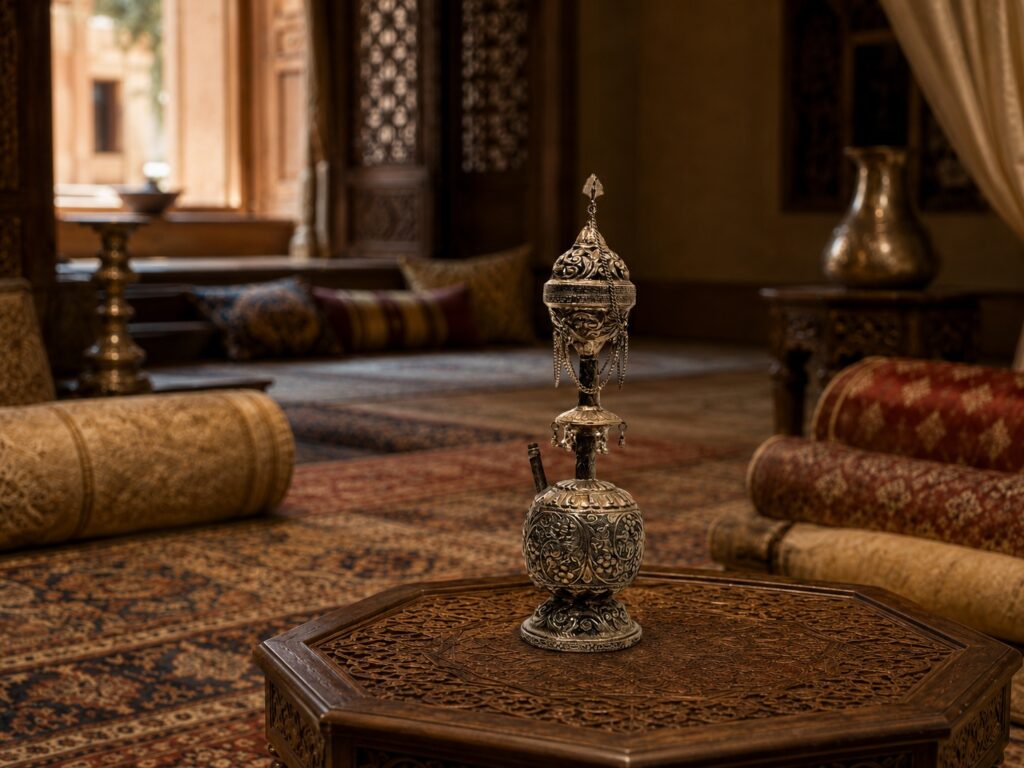
Nearly every surface of this towering Indian water pipe is alive with decoration. Peacocks emerge from dense flowering vines. Delicate chains descend from its domed upper chamber. Hammered floral panels cover the rounded reservoir, while flashes of warm copper appear beneath its worn silver-colored surface.
Created in India during the 19th century, this elaborate huqqa was more than a device for smoking. Now preserved by the History of Smoke Museum, the hookah offers a remarkable window into the material culture of smoking in colonial-era India. Its construction connects the practical mechanics of the water pipe with the enduring influence of Mughal floral design, Indian metalworking traditions, and the symbolic presence of the peacock.
What Is a Huqqa?
The word huqqa is the historically appropriate Indian term for the object now commonly called a hookah. Water pipes are known under several regional names, including qalyan in Persian and narghileh or shisha in Arabic.
The precise origin of the water pipe remains debated. The British Museum places its development near the beginning of the 17th century and notes that it may have originated in either India or Iran. In India, the form became known as the huqqa or hookah.
Although surviving examples vary greatly in size and material, the basic mechanism is relatively consistent.
Tobacco was placed in a bowl near the top of the pipe and heated, traditionally with glowing charcoal. The resulting smoke traveled downward through an internal tube into a reservoir partially filled with water. As the smoker inhaled through a flexible hose, the smoke passed through the water before entering the hose and mouthpiece.
The History of Smoke Museum example retains its rounded water reservoir, central stem, upper housing, and side hose connection. The original flexible hose and mouthpiece are no longer present.
The Rise of Hookah Culture in India
By the 17th and 18th centuries, hookah smoking had become deeply embedded in Indian social life. Water pipes appeared in royal courts, affluent households, reception rooms, gardens, and private apartments.
They were used during conversation, hospitality, political meetings, and periods of leisure. In paintings, the hookah frequently appears beside rulers, nobles, merchants, attendants, and elegantly dressed women.
A painting in the Metropolitan Museum of Art shows a raja seated on a carpeted terrace at Kota, holding a hookah hose while resting against a bolster. A container for pan, or betel nut, sits nearby, placing the hookah within a larger culture of courtly leisure and hospitality.
The Met also describes hookahs as widespread in later Hindu courts and notes that they became recurring accessories in royal portraiture. Their connection with nobility encouraged the production of elaborate versions in prestigious materials such as silver, bidri ware, and painted glass.
Hookah use was not limited exclusively to royalty. Water pipes circulated across different communities and levels of society. Their materials and ornament, however, could reveal a great deal about the setting in which they were intended to be used.
A basic clay or undecorated metal hookah might have served an ordinary household or traveler. A tall, heavily ornamented example with a silver-colored surface, suspended chains, and extensive hand-worked decoration would have been far more costly and visually commanding.
The scale and workmanship of the History of Smoke Museum hookah suggest that it was likely created for an affluent North Indian household, prosperous merchant family, court-connected patron, or formal reception setting.
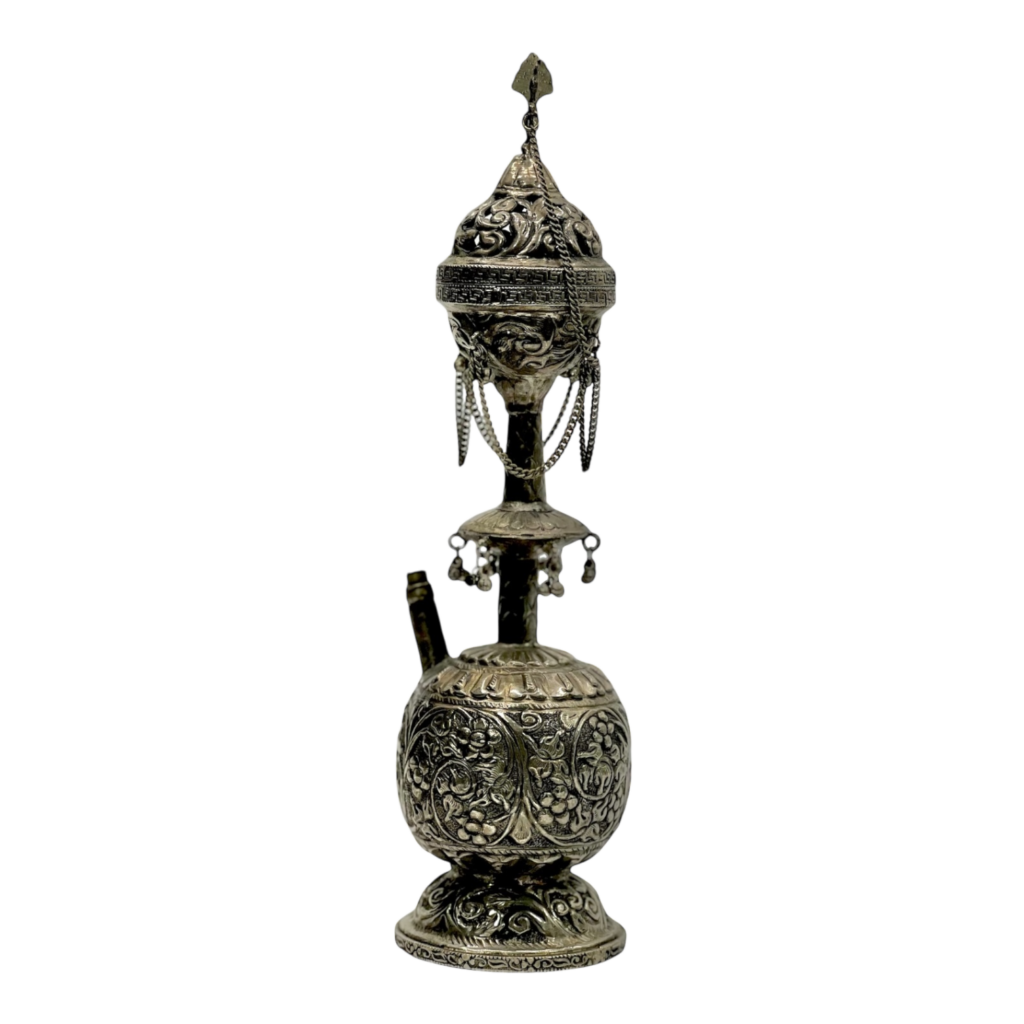
Examining the History of Smoke Museum Hookah
Indian Silvered-Copper Huqqa with Peacock and Floral Decoration
North India, possibly Kashmir or Delhi
Mid-to-late 19th century, approximately 1850–1900
Worked copper with a silver-colored surface
The hookah is composed of several separately formed sections joined into one tall architectural structure.
At its base is a wide circular foot decorated with raised scrolling foliage. Above it sits the rounded water reservoir, the largest and most visually prominent section of the pipe.
The reservoir is divided into ornamental panels filled with flowers, leaves, curling vines, and stylized peacocks. A band of elongated petal-like forms encircles its shoulder.
A short angled socket projects from the side of the reservoir. This would originally have held the flexible hose through which the smoker inhaled.
The reservoir supports a narrow central stem and a flared transitional plate ornamented with suspended metal drops. Above this rises the elaborate upper assembly, which appears to have enclosed or supported the tobacco bowl and charcoal area.
The upper chamber is crowned by a pointed dome and a leaf- or spear-shaped finial. Decorative chains descend around the chamber in hanging swags, giving the entire pipe a sense of movement and vertical drama.
Its silhouette resembles a small pavilion, canopy, tower, or architectural shrine. This architectural quality was likely intentional: the hookah was both a functioning water pipe and an ornamental furnishing.
Copper Beneath a Silver Surface
The hookah appears to have been constructed primarily from copper or a copper-rich alloy. In areas where the silver-colored surface has worn away, warmer reddish-brown metal is visible beneath.
The exterior may represent:
- genuine silver plate;
- another form of silvering;
- tinning applied over copper;
- or a combination of finishes used on separate components.
Without metallurgical testing, it is safest to describe the object as silvered copper rather than definitively identifying the coating as heavy silver plate.
A nondestructive X-ray fluorescence test, commonly known as XRF, could determine whether the outer surface contains silver, tin, nickel, zinc, or another metal. Because the hookah consists of multiple joined components, several areas would need to be tested.
Copper was well suited to this type of object. It could be hammered into rounded forms, worked into relief, engraved, repaired, and covered with a more prestigious silver-colored finish. It also allowed craftspeople to produce a large and impressive object without the extraordinary cost and weight of solid silver.
Indian hookahs were made in a wide variety of luxury materials. Museum collections include silver-and-enamel huqqa bases from Lucknow, gilded glass examples from Mughal India, and bidri ware bases created from dark zinc alloy inlaid with contrasting metals.
The History of Smoke Museum example belongs to this broader tradition of transforming a functional smoking device into an object of decorative art.
How Was the Decoration Made?
The ornament was not simply printed or mechanically stamped onto a finished vessel. Its raised and recessed surfaces indicate the use of traditional hand-working techniques.
Repoussé
In repoussé work, the metal is hammered from the reverse side to push the principal shapes outward. This creates the raised flowers, leaves, birds, and scrolling forms visible across the hookah.
Chasing
After the design has been raised, the artisan works from the front using small tools and controlled hammering. This process, called chasing, sharpens outlines, deepens recesses, and gives definition to individual petals, feathers, and tendrils.
Engraving and Punching
Fine lines and textured backgrounds may then be added through engraving or punching. These details help separate overlapping motifs and make the decoration more legible when light passes across the metal.
Assembly
The reservoir, stem, foot, upper housing, chains, finial, hose socket, and hanging ornaments were likely made separately. They were then joined through soldered seams, fitted collars, threaded connections, or pressure-fitted components.
The proper technical description is therefore hand-hammered, repoussé, chased, engraved, and assembled metalwork.
Who May Have Used This Hookah?
It is impossible to identify the original owner from the object alone. The hookah does, however, reveal clues about the kind of environment for which it was made.
Its size, complicated construction, layered ornament, decorative chains, and silvered finish indicate that it was not a basic utilitarian pipe. It was intended to occupy visible space and attract attention.
It may have belonged to:
- an affluent urban household;
- a prosperous merchant family;
- a landholding household;
- a court-connected patron;
- or an establishment used for formal hospitality.
The hookah may have been placed beside low seating, carpets, cushions, or a reception platform. An attendant could prepare the tobacco and charcoal, fill the reservoir with water, attach the hose, and present the mouthpiece to the smoker.
In this environment, the hookah functioned as both a social instrument and a decorative centerpiece.
Its presence could communicate generosity, refinement, and the household’s ability to commission or acquire elaborate handmade metalwork.
Peacocks, Flowers, and the Indian Garden
Among the most fascinating elements on the hookah are the stylized peacocks worked into the reservoir.
The birds are surrounded by dense floral sprays, scrolling vines, leaves, and clusters resembling fruit or buds. Together, these motifs create the impression of a luxuriant ornamental garden.
The flowers should not necessarily be interpreted as exact botanical species. Indian metalworkers frequently combined recognizable blossoms, leaves, and imaginary plant forms into balanced decorative compositions.
The peacock has occupied an important place in Indian visual culture for centuries. It may evoke beauty, abundance, royalty, seasonal renewal, natural splendor, or auspicious presence. It also appears in religious, courtly, architectural, and domestic art across numerous regions and traditions.
Its appearance does not prove that this hookah was owned by royalty. Rather, it connects the object to an established and prestigious vocabulary of Indian decoration.
The floral ornament also reflects the continuing influence of Mughal art. The Metropolitan Museum’s late-19th-century design for an Indian hookah base contains multiple floral patterns specifically described as Mughal-inspired.
Mughal decorative traditions often emphasized ordered gardens, flowering plants, symmetry, and the close observation of nature. During the 19th century, artisans continued to adapt these motifs long after the height of Mughal political power.
On this hookah, peacocks and flowers do more than fill empty space. They transform the reservoir into a miniature symbolic garden.
What Appears to Survive?
The hookah is substantially complete compared with many surviving museum examples, which often consist only of the water reservoir.
Visible surviving components include:
- the broad foot;
- rounded water chamber;
- side hose connection;
- central stem;
- flared transitional or ash-catching plate;
- upper bowl housing;
- domed cover;
- chains;
- hanging ornaments;
- and pointed finial.
The original flexible hose and mouthpiece are absent. A removable inner tobacco cup, charcoal support, gasket, or screen may also be missing.
Some hanging pendants appear irregular or incomplete. It is also possible that the object underwent historical repairs or that individual parts were replaced during its working life.
A close physical inspection of its joints, threads, solder seams, and internal stem would help determine whether every major component was made together.
Was It Made in Kashmir, Delhi, Lucknow, or Elsewhere?
The exact workshop and region of manufacture remain uncertain.
Several North Indian centers produced elaborate hookahs and finely decorated metalwork during the 19th century. The dense floral ornament and silver-colored copper surface make a Kashmiri attribution possible, while the tall structure and late Mughal decorative vocabulary could also point toward Delhi or another northern urban center.
Kashmir
Kashmiri metalwork is known for densely arranged flowers, vines, leaves, and all-over surface ornament. Copper objects were frequently hammered, engraved, chased, tinned, or otherwise finished to produce visually rich surfaces.
The crowded floral composition of this hookah is consistent with that general tradition, although no visible workshop mark confirms a Kashmiri origin.
Delhi and North India
Delhi remained an important center of Indo-Persian and late Mughal artistic culture. Metalworkers continued to produce objects incorporating floral arabesques, architectural forms, and courtly decorative traditions during the 19th century.
The hookah’s tall sectional construction, dome-shaped upper chamber, peacock imagery, and luxurious presentation are compatible with a Delhi or broader North Indian attribution.
Lucknow
Lucknow was another major center for sophisticated hookah production. A mid-19th-century huqqa base in the Metropolitan Museum is attributed to India, probably Lucknow, and is constructed from silver with enamel.
The History of Smoke Museum hookah lacks the colorful enamel associated with that particular type of Lucknow work, although this alone does not rule out the region.
The Deccan and Moradabad
The Deccan and Moradabad were especially associated with bidri ware hookah bases. These objects were generally made from dark zinc alloy and decorated with contrasting silver or brass inlay.
The British Museum holds a 19th-century Deccan huqqa base with floral and vegetal ornament inlaid into zinc alloy. The Met also holds a 19th-century Moradabad water-pipe base made from engraved zinc alloy inlaid with silver.
Because the History of Smoke Museum hookah appears to be copper with an applied silver-colored surface rather than dark bidri alloy, it belongs to a different metalworking tradition.
Until marks, documented provenance, or scientific testing provide stronger evidence, the most responsible attribution is:
North India, possibly Kashmir or Delhi.
Wear as Historical Evidence
The worn surface should not be considered merely a flaw.
Areas of exposed copper, darkened recesses, small dents, uneven chains, and polished high points all contribute information about the object’s history.
They may reveal:
- repeated handling;
- old cleaning practices;
- heat exposure;
- friction from assembly and disassembly;
- the composition of the underlying metal;
- historical repairs;
- and the ways in which the hookah was stored or displayed.
Aggressive polishing could remove surviving silvering, reduce the contrast of the decoration, and erase evidence of age. Commercial silver polish should therefore be avoided until the exact surface material has been identified.
Conservation should prioritize stability and preservation rather than making the object appear newly manufactured.
Why This Indian Hookah Matters
This hookah is significant not simply because it is ornate.
It brings together multiple histories within a single surviving object:
- the development of the water pipe;
- the spread of tobacco culture;
- Indian hospitality and social customs;
- courtly and domestic display;
- copperworking and surface finishing;
- repoussé and chasing;
- peacock symbolism;
- and the survival of Mughal-inspired design into the 19th century.
Its chains, floral relief, worn silver surface, architectural upper chamber, and surviving smoke system turn an abstract history into something tangible.
This was an object meant to be prepared, handled, admired, and shared. It once occupied a living social space filled with conversation, movement, heat, scent, and ritualized hospitality.
Today, it survives as both a work of decorative art and a document of social history.
Preserved by the History of Smoke Museum, the hookah invites us to look beyond tobacco itself and consider the extraordinary objects, artistic traditions, and human relationships that developed around the culture of smoke.
Object Summary
Object: Huqqa, or hookah water pipe
Culture: Indian
Region: North India, possibly Kashmir or Delhi
Date: Mid-to-late 19th century, approximately 1850–1900
Material: Worked copper with a silver-colored surface
Techniques: Hammering, repoussé, chasing, engraving, punching, soldering, and assembly
Decoration: Peacocks, flowering vines, foliage, lotus-derived borders, chains, and suspended ornaments
Probable setting: An affluent household or formal reception environment
Collection: History of Smoke Museum